A Dynamical Equilibrium Linking Nanohertz Stochastic Gravitational Wave Background to Cosmic Structure Formation

A Dynamical Equilibrium Linking Nanohertz Stochastic Gravitational Wave Background to Cosmic Structure Formation
Manjia Liang, Peng Xu, Ruijun Shi, Zhoujian Cao, Ziren Luo, Minghui Du, Qiong Deng, Bo Liang, Jiaxiang Liang
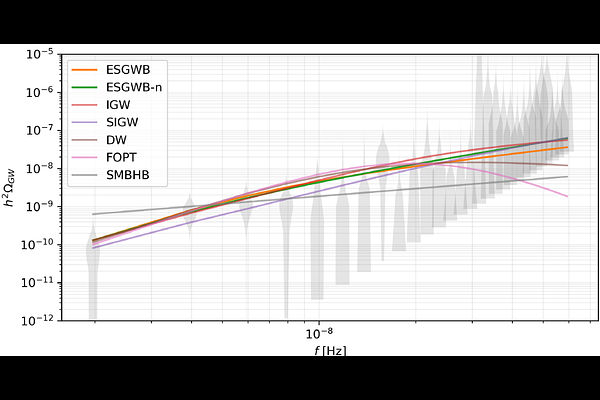
AbstractThe stochastic gravitational wave background (SGWB) is conventionally treated as a passive relic of its astrophysical and cosmological sources, with negligible back-reaction on the matter content of the Universe. Here we show that this assumption needs to be modified once the SGWB and matter are treated as a dynamically coupled non-equilibrium system. Combining linearized general relativity with the fluctuation-dissipation theorem, we derive a generalized Langevin framework that drives the coupled system toward a dynamical equilibrium, which is characterized by a distinctive strain spectrum with a high-frequency cutoff $\mathcal{W}$, and a scale-dependent coupling parameter that screens gravity progressively for the most massive structures. Three findings support this framework. Fitting the equilibrium spectrum to the NANOGrav 15-year dataset yields a Bayes factor of $48\pm 3.8$ over the supermassive black hole binary baseline, achieved entirely within general relativity and the Standard Model. The PTA-calibrated screening mass scale $m_{c}\sim 10^{12}\text{--}10^{14}\,M_{\odot}$ overlaps, with no free cosmological parameter, the $Λ$CDM-derived linear-to-nonlinear transition mass $M_{\rm NL}$ of cosmic structure at $\sim 8\,h^{-1}\,\mathrm{Mpc}$. Most strikingly, promoting this concordance to a structural identification expresses $\mathcal{W}$ entirely in terms of $M_{\rm NL}$, and its inverse acquires a transparent physical reading as a coherence threshold for SGWB-matter coupling. $\mathcal{W}$ is thereby a derived quantity linking nanohertz gravitational-wave observables to the late-time cosmological sector. The framework makes distinctive scale-dependent predictions testable by forthcoming large-scale structure surveys and space-borne gravitational-wave observatories.