Grain-size evolution and rapid dust growth in high-redshift galaxies

Grain-size evolution and rapid dust growth in high-redshift galaxies
Daisuke Toyouchi, Andrea Ferrara, Yurina Nakazato, Kosei Matsumoto, Raffaella Schneider, Koki Otaki
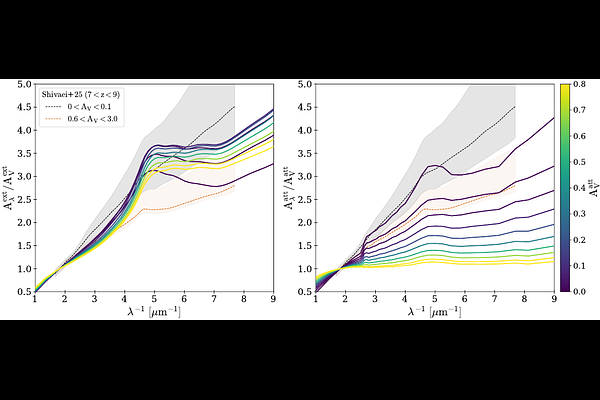
AbstractWe present a galaxy evolution model that incorporates grain-size evolution in a multiphase interstellar medium (ISM) to investigate dust attenuation in galaxies at $z \geq 5$. Our fiducial setup assumes a low dust yield of $y_{\rm d} = 10^{-4}~\rm M_\odot$ and a small characteristic size of stellar dust of $a_0 = 0.01~μ$m, motivated by efficient dust destruction by reverse shocks in dense ISM environments. Our model demonstrates that, even with such low dust yields, massive galaxies with $M_\ast > 10^9~\rm M_\odot$ reach high dust-to-stellar mass ratios of $M_{\rm d}/M_\ast \sim 10^{-2}$ by $z \sim 7$ because small grains supplied by SNe efficiently serve as seeds for metal accretion in the ISM. Because dust growth significantly lags behind star formation, the outer regions beyond the half-star-formation-rate radius remain relatively dust poor, allowing a non-negligible fraction of UV photons to escape without strong attenuation. We further find that dust growth becomes most efficient when the ISM is dominated by cold dense gas but still contains a modest warm component, as the former promotes metal accretion while the latter supplies additional small grains through shattering, thereby further enhancing subsequent grain growth. In particular, with a cold dense gas fraction of $\sim 90~\%$, our model predictions become broadly consistent with the dust-to-stellar mass ratios inferred for dust-rich galaxies at $z \sim 7$, as well as the upper limits for blue galaxies at $z \gtrsim 10$. Self-consistently, the model successfully reproduces the UV luminosity functions observed at both $z = 7$ and $z = 12$. Overall, this study demonstrates that a physically motivated treatment of grain growth in a multiphase ISM is essential for linking the dust content of high-redshift galaxies to their radiative properties during cosmic dawn.