Amortized Simulation-Based Inference of Colliding-Wind Binaries from Short, Noisy Image Time Series

Amortized Simulation-Based Inference of Colliding-Wind Binaries from Short, Noisy Image Time Series
Niklas Knöll, Tobias Buck, Lorenzo Branca, Giuseppe Viterbo
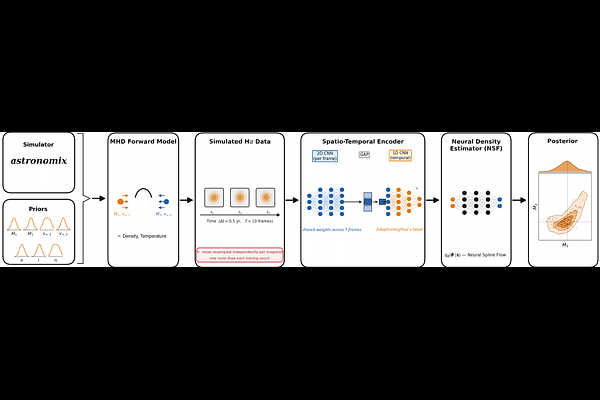
AbstractColliding-wind binaries (CWBs), which are systems of two massive stars whose supersonic winds collide into bow shocks, encode rich information about stellar wind properties in their multi-frequency emission, e.g. images in the H$α$, X-ray, and radio wavelengths. Inferring physical parameters (mass-loss rates, terminal wind velocities, orbital elements) from short time-series observations is a compelling but challenging inverse problem, because the forward hydrodynamic simulator is computationally expensive and the likelihood is intractable. We adopt a factorized spatio-temporal architecture for amortized posterior inference that separates spatial encoding from temporal aggregation. This design aligns with the structure of the underlying physical process of local morphology and global dynamical evolution, induces time-translation equivariance in the learned representation, and improves identifiability in low-signal regimes. Coupled with a neural spline flow conditioned on these spatio-temporal embeddings of 10-frame H$α$ photon-count time series, we present a complete simulation-based inference pipeline for CWBs. Our method jointly infers seven physical parameters from synthetic observations under realistic detector noise, with posteriors verified as well-calibrated via TARP and SBC diagnostics. The approach naturally expands posterior width in information-poor regimes (low photon counts) and robustly recovers orbital parameters and mass-loss rates, demonstrating the feasibility of amortized likelihood-free inference for this challenging astrophysical inverse problem.