Lensing ratios as a geometric probe of dark energy in the LSST and Simons Observatory era

Lensing ratios as a geometric probe of dark energy in the LSST and Simons Observatory era
Judit Prat, Carles Sánchez
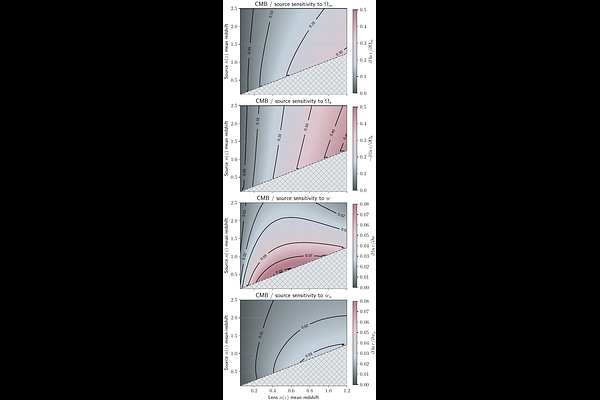
AbstractRatios of galaxy-CMB and galaxy-galaxy lensing around the same foreground galaxies probe relative distances extending to recombination without a standard candle or ruler. For sufficiently narrow foreground redshift distributions, and with intrinsic alignments and lens magnification controlled, these lensing ratios (LRs) become geometrical. Here we characterize the geometrical limit and develop an end-to-end optimized framework for the probe with LSST Y10 and Simons Observatory uncertainties. In our forecast for LSST Y10, the individual ratios are measured to a median precision of 1.0%, with a total signal-to-noise ratio of 360. We then study the complementarity of LRs as an additional geometrical probe to constrain dark energy and curvature. We find that LRs improve the $w_0$-$w_a$ figure of merit of the combined CMB, Type Ia supernova, and baryon acoustic oscillation (BAO) data by 15%, after marginalizing over systematic uncertainties. As an independent geometric probe, they also enable competitive leave-one-out tests, in which one of the probes is dropped, and we find they are most effective at replacing the BAO: adding LRs to CMB+supernova raises the figure of merit from 33% to 66% of that of the full CMB+supernova+BAO combination. We also find LRs are especially valuable in extended model spaces constrained with minimal assumptions: in a seven-bin reconstruction of the dark-energy density, they reduce per-bin uncertainties by up to 16% at $z>1$, and by up to 50% when freeing curvature and dropping the non-geometrical part of the CMB likelihood (i.e. keeping the acoustic angular scale part), where they are able to break the degeneracy between curvature and dark energy.