Microphysical Model of Jupiter's Great Red Spot Upper Chromophore Haze

Microphysical Model of Jupiter's Great Red Spot Upper Chromophore Haze
Asier Anguiano-Arteaga, Santiago Perez-Hoyos, Agustin Sanchez-Lavega, Patrick G. J. Irwin
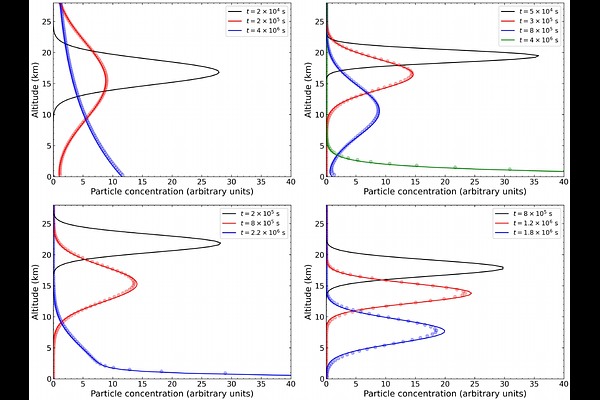
AbstractThe origin of the red colouration in Jupiter's Great Red Spot (GRS) is a long-standing question in planetary science. While several candidate chromophores have been proposed, no clear conclusions have been reached regarding its nature, evolution, or relationship to atmospheric dynamics. In this work, we perform microphysical simulations of the reddish haze over the GRS and quantify the production rates and timescales required to sustain it. Matching the previously reported chromophore column mass and effective radius in the GRS requires column-integrated injection fluxes in the range $1\times10^{-12}$-$7\times10^{-12}$ kg m$^{-2}$ s$^{-1}$, under low upwelling velocities in the upper troposphere ($v_{\mathrm{trop}}\lesssim 1.5\times10^{-4}$ m s$^{-1}$) and particle charges of at least 20 electrons per $μ$m. Such rates exceed the mass flux that standard photochemical models of Jupiter currently supply via NH$_3$-C$_2$H$_2$ photochemistry at 0.1-0.2 bar, the most popular chromophore pathway in recent literature. We find a lower limit of 7 years on the haze formation time. We also assess commonly used size and vertical distribution parameterisations for the chromophore haze, finding that eddy diffusion prevents the long-term confinement of a thin layer and that the extinction is dominated by particles that can be represented by a single log-normal size distribution.