ALMA High-J CO Spectroscopy of High-Redshift Galaxies. II. 0.03" Resolution CO Kinematics Reveal Super-Eddington Accretion in a Dust-Obscured Galaxy at z=3.111

ALMA High-J CO Spectroscopy of High-Redshift Galaxies. II. 0.03" Resolution CO Kinematics Reveal Super-Eddington Accretion in a Dust-Obscured Galaxy at z=3.111
Ken-ichi Tadaki
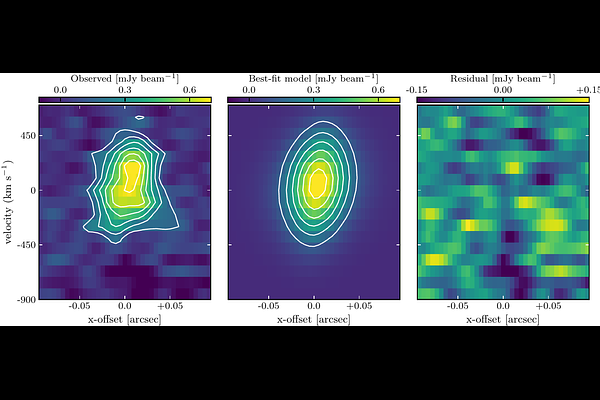
AbstractWe present ultra-high-resolution (0.03"~230 pc) Atacama Large Millimeter/submillimeter Array (ALMA) observations of the hyperluminous dust-obscured galaxy W2305-0039 at z=3.111, targeting the CO J=7-6 and J=11-10 lines. The CO(11-10) emission is extremely compact and exhibits anomalously high excitation relative to CO(7-6) within the central <500 pc. X-ray-dominated region models successfully reproduce this excitation, providing strong evidence for intense X-ray irradiation by a deeply obscured active galactic nucleus (AGN), while photodissociation-region models fail to match the observed ratio. Forward modeling of the nuclear CO(11-10) position-velocity diagram yields a dynamical black-hole mass of log(M$_{\rm BH}$/M$_{\odot}$) = 8.3$^{+0.7}_{-0.6}$ and an intrinsic gas velocity dispersion of $277~^{+16}_{-14}$ km s$^{-1}$. Combined with the AGN luminosity from infrared spectral energy distribution decomposition, these measurements imply a highly super-Eddington accretion state with $λ~_{\rm Edd}~\gtrsim 4$. Our results provide dynamical evidence that the most rapid phases of black-hole growth can occur within a compact, heavily obscured nuclear region. Extending ALMA beyond its current 16 km maximum baselines will be essential for pushing such dynamical measurements to tens-of-parsec scales and resolving the black-hole sphere of influence in massive galaxies at $z \gtrsim 6$.