A precessing jet from a supermassive black hole: multi-wavelength observations of S5 1044+71

A precessing jet from a supermassive black hole: multi-wavelength observations of S5 1044+71
M. Cerruti, P. A. Duverne, G. Ganesaratnam, P. Goswami, H. X. Ren, N. Sahakyan
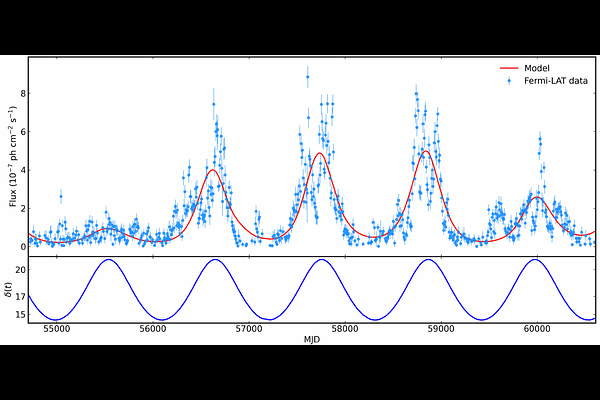
AbstractThe bright gamma-ray blazar S5 1044+71 has been identified as showing very significant quasi-periodic oscillations in the Fermi-LAT data in recent studies, with a periodicity of about 3 years. With the completion of a new gamma-ray cycle, we aim to revisit the periodicity in Fermi-LAT data, and analyze all available multi-wavelength (MWL) data to search for possible correlations and time-lags. These observations will be used to test for the compatibility of the observed periodicity with a precessing jet from the supermassive black hole. We analyze data from Fermi-LAT, NuSTAR, Swift, AstroSat, ASAS-SN, ZTF, Pan-STARRS, and NEOWISE. In addition we present an analysis from historical observations from Palomar and Pulkovo. Single-band spectral variability, MWL correlations, and cross-correlations are computed. We then model the Fermi-LAT light curve with a precessing jet model, providing constraints on the geometry of the system and providing the evolution of the Doppler factor with time. The latter is used as input for MWL fitting of the spectral energy distribution. We confirm previous claims on the existence of a periodic gamma-ray signal. We detect significant spectral variability in gamma-ray, X-rays, and optical/UV data. We detect significant correlation between low-energy (infrared/optical/ultraviolet) data and gamma-rays, with a correlation index of about 1; the correlation between X-rays and gamma-ray is milder, with a correlation index of about 0.3. We do not detect any significant time-lag between bands. The Fermi-LAT light curve is successfully fit by a precessing jet model. The fit to the spectral energy distributions indicate that S5 1044+71 is a typical blazar, in which the gamma-ray emission is located beyond the broad-line region. All MWL observations we present in this work are consistent with the existence of a precessing relativistic jet from the supermassive black hole.