Distribution of energy release events due to magnetic braiding

Distribution of energy release events due to magnetic braiding
David I. Pontin, Klaus Galsgaard, James A. Klimchuk
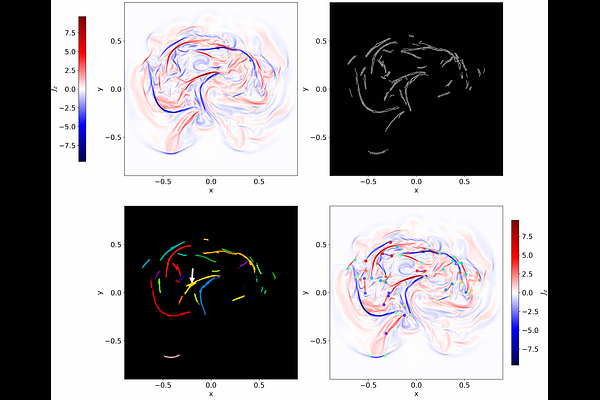
AbstractEnergy conversion by reconnection-powered nanoflare heating is one of the leading explanations for the heating of the solar chromosphere and corona. The aim of this paper is to shed light on this mechanism by exploring the magnetic Reynolds number dependence of the energy conversion process. To do this we employ boundary-driven, magnetohydrodynamic, flux-braiding simulations at different magnetic Reynolds numbers ($R_m$), and explore in detail the properties of the individual magnetic energy release events. The properties of the reconnecting current sheets that mediate the energy release are shown to depend on $R_m$. For increasing $R_m$, the current sheets become thinner, more intense, and more numerous. For sufficiently large $R_m$, the current sheets fragment along their length, leading to a sharp cutoff in the current sheet length distribution. The cutoff is consistent with the threshold for non-linear tearing/plasmoid instability. For increasing $R_m$ the magnetic field lines become increasingly tangled, the mean and peak values of the magnetic field strength increase, and the Poynting flux into the domain increases, implying that the heating rate also increases. The global reconnection rate is essentially independent of $R_m$. These results support the braiding mechanism as a viable way to effectively heat the internal portions of coherent flux tubes in the corona.