Alleviating prior dependencies for DESI DR1 clustering fits through reparameterization

Alleviating prior dependencies for DESI DR1 clustering fits through reparameterization
Marco Bonici, Simone Paradiso, Glenn McGee, Guido D'Amico, Minas Karamanis, Hanyu Zhang, Will Percival, Jessica Nicole Aguilar, Steven Ahlen, Davide Bianchi, David Brooks, Francisco Javier Castander, Todd Claybaugh, Axel de la Macorra, Biprateep Dey, Peter Doel, Simone Ferraro, Andreu Font-Ribera, Jaime E. Forero-Romero, Enrique Gaztañaga, Satya Gontcho A Gontcho, Gaston Gutierrez, ChangHoon Hahn, Klaus Honscheid, Mustapha Ishak, Dick Joyce, Robert Kehoe, Theodore Kisner, Anthony Kremin, Ofer Lahav, Claire Lamman, Martin Landriau, Laurent Le Guillou, Marc Manera, Aaron Meisner, Ramon Miquél, Gustavo Niz, Francisco Prada, Ignasi Pérez-Ràfols, Graziano Rossi, Lado Samushia, Eusebio Sanchez, Edward Schlafly, David Schlegel, Joseph Harry Silber, David Sprayberry, Gregory Tarlé, Mariana Vargas Magana, Benjamin Alan Weaver, Pauline Zarrouk, Hu Zou
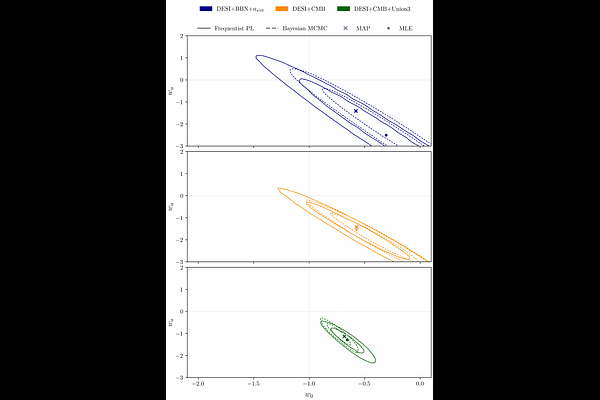
AbstractBayesian analyses of the full-shape clustering of Dark Energy Spectroscopic Instrument (DESI) Data Release 1 (DR1) exhibit prior-volume projection effects, whereby weakly constrained nuisance parameters of the Effective Field Theory of Large Scale Structure (EFTofLSS) shift marginalized cosmological posteriors away from the posterior maximum. We reanalyze DESI DR1 power spectrum multipoles using two complementary mitigation strategies: (i) nonlinear orthogonalization to decorrelate nuisance and cosmological parameter priors, and (ii) a fully reparameterization-invariant Jeffreys prior over all EFTofLSS coefficients, evaluated on-the-fly via closed-form Jacobians. Including data from DESI, Big-Bang Nuclesynthesis and a constraint on $n_{\mathrm{s}}$, baseline priors lead to multi-$σ$ projection in the Hubble parameter $H_{0}$ and dark energy equation of state parameters $w_{0}$ and $w_{a}$; the Jeffreys prior successfully recenters these posteriors to enclose the maximum a posteriori estimate within the 68\% credible regions, demonstrating clear mitigation of projection effects for these late-time expansion parameters. A hybrid Jeffreys+baseline-Gaussian configuration controls residual over-broad tails in the physical cold dark matter density $ω_{\mathrm{c}}$ while preserving the volume correction, and is our favoured approach. We compare the credible intervals derived using our methodology to those obtained using Halo Occupation Distribution (HOD)-informed priors and to confidence intervals derived using frequentist profile likelihood analyses, finding agreement in both central values and degeneracy directions in the $w_{0}$--$w_{a}$ plane. This demonstrates that, once projection effects are properly controlled, we can make robust inferences about the late-time cosmological expansion independent of the statistical framework adopted.