A Step-Like Transition Underlying the Life and Death of Galaxies

A Step-Like Transition Underlying the Life and Death of Galaxies
Zhicheng He, Enci Wang, Luis C. Ho, Yingjie Peng, Huiyuan Wang, Yong Shi, Tao Wang, Yongquan Xue, Tinggui Wang
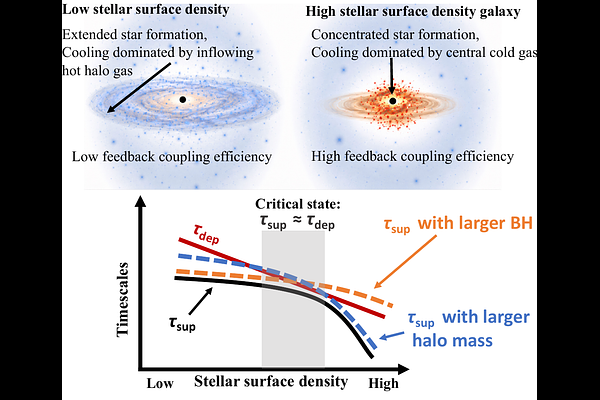
AbstractHow galaxies stop forming stars is a complex and central problem in astrophysics. Numerous physical mechanisms have been proposed, yet a simple, unified framework connecting these mechanisms remains lacking. Here, we derive a step-function quenching response from the fundamental principle of gas mass conservation, governed by the competition between gas-supply and gas-depletion timescales. This response also enables the gas-supply timescale to be inferred from the observed quenched fraction. Applying this method to approximately 350,000 galaxies, we find a characteristic gas-supply timescale of ~1 Gyr, reveal distinct inside-out and outside-in quenching signatures associated with supermassive black holes and dark matter halos, respectively, and identify galaxies with intermediate stellar surface mass densities as occupying a critical state for quenching and rejuvenation. Our work establishes a unified physical framework in which a simple step-function response captures how diverse physical processes regulate galaxy quenching and the resumption of star formation through their effects on the competition between gas-supply and gas-depletion timescales.