A Chemodynamical Census of the Milky Way's Ultra-Faint Compact Satellites. I. A First Population-Level Look at the Internal Kinematics and Metallicities of 19 Extremely-Low-Mass Halo Stellar Systems

A Chemodynamical Census of the Milky Way's Ultra-Faint Compact Satellites. I. A First Population-Level Look at the Internal Kinematics and Metallicities of 19 Extremely-Low-Mass Halo Stellar Systems
William Cerny, Ting S. Li, Andrew B. Pace, Joshua D. Simon, Marla Geha, Alexander P. Ji, Alex Drlica-Wagner, Jordan Bruce, Oleg Y. Gnedin, Eric F. Bell, Sidney Mau, Ivanna Escala, Daisy Bissonette, Alessandro Savino, Anirudh Chiti, Evan N. Kirby
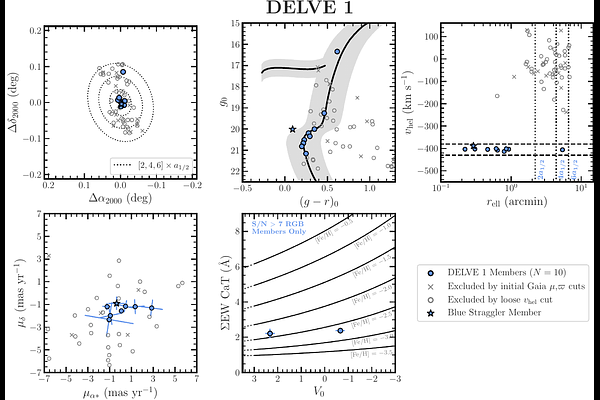
AbstractDeep, wide-area photometric surveys have uncovered a population of compact ($r_{1/2} \approx$ 1-15 pc), extremely-low-mass ($M_* \approx$ 20-4000 $M_{\odot}$) stellar systems in the Milky Way halo that are smaller in size than known ultra-faint dwarf galaxies (UFDs) and substantially fainter than most classical globular clusters (GCs). Very little is known about the nature and origins of this population of "Ultra-Faint Compact Satellites" (UFCSs) owing to a dearth of spectroscopic measurements. Here, we present the first spectroscopic census of these compact systems based on Magellan/IMACS and Keck/DEIMOS observations of 19 individual UFCSs, representing $\sim$2/3 of the known population. We securely measure mean radial velocities for all 19 systems, velocity dispersions for 15 (predominantly upper limits), metallicities for 17, metallicity dispersions for 8, and $\textit{Gaia}$-based mean proper motions for 18. This large new spectroscopic sample provides the first insights into population-level trends for these extreme satellites. We demonstrate that: (1) the UFCSs are kinematically colder, on average, than the UFDs, disfavoring very dense dark matter halos in most cases, (2) the UFCS population is chemically diverse, spanning a factor of $\sim$300 in mean iron abundance ($\rm -3.3 \lesssim [Fe/H] \lesssim -0.8$), with multiple systems falling beneath the "metallicity floor" proposed for GCs, and (3) while some higher-metallicity and/or younger UFCSs are clearly star clusters, the dynamical and/or chemical evidence allows the possibility that up to $\sim$50% of the UFCSs in our sample (9 of 19) may represent the smallest and least-massive galaxies yet discovered.