The Galaxy Stellar Mass-SFR-Size Relation in EAGLE, TNG100, and Observations

The Galaxy Stellar Mass-SFR-Size Relation in EAGLE, TNG100, and Observations
Jiani Chu, Dandan Xu, Enci Wang, Stijn Wuyts
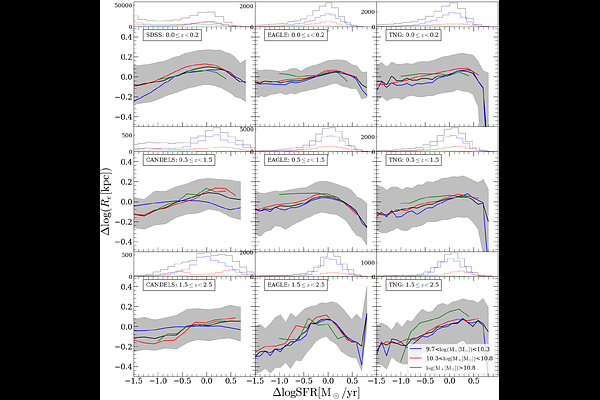
AbstractStellar mass, size, and star formation rate (SFR) are fundamental properties that encode the structural and evolutionary states of galaxies. Observations reveal a mass-SFR-size relation whereby galaxies become more compact both above and below the ridge of the star-forming main sequence (SFMS), linking galaxy structure to star formation activity. We investigate this relation by comparing galaxies from two cosmological hydrodynamical simulations, EAGLE and TNG100, with observational samples from SDSS and CANDELS over three redshift intervals (0 < z < 0.2, 0.5 < z < 1.5, and 1.5 < z < 2.5). Both simulations reproduce the observed trend that galaxy sizes decrease with increasing offset away from the SFMS. This trend, however, weakens and is not detected in the observational sample at 1.5 < z < 2.5, likely due to increased measurement uncertainties. In contrast, the trend persists in both simulations up to z = 2.5. Across all redshifts, EAGLE predicts a stronger size dependence on SFMS offset than observed, whereas TNG100 exhibits a weaker dependence. We discuss how this mass-SFR-size relation can be understood in terms of different time variability in star formation rate across the SFMS.