Binary neutron star mergers with a subsolar mass star

Binary neutron star mergers with a subsolar mass star
Maxence Corman, William E. East, Jocelyn S. Read
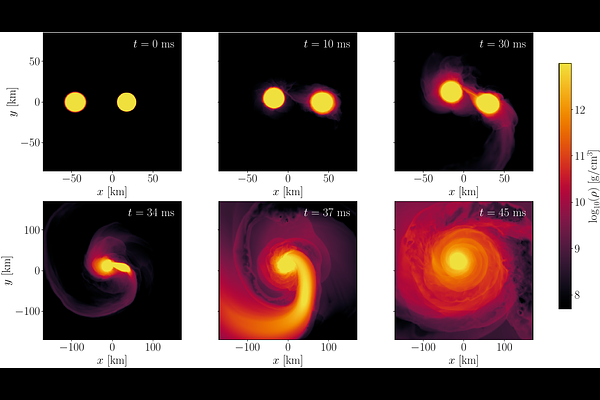
AbstractWhile there are a number of proposed formation channels for subsolar mass compact objects, including black holes formed primordially, or neutron stars that form in collapsar disks, there have yet to be any conclusive observations of such objects. Motivated by the possibility that, if such objects exist, gravitational waves from binary mergers may reveal them, we study binary neutron star mergers where one star has a subsolar-mass in order to determine how well such systems are described by current models, and when they could be distinguished from a system with a subsolar-mass black hole. We perform fully general-relativistic simulations of a $1.7\ M_{\odot}$ star merging with a $0.8\ M_{\odot}$ star, leading to tidal deformabilities of up to $\mathcal{O}(10^4)$ for the latter, and quantify how this affects the merger dynamics and associated gravitation and electromagnetic signals. In this regime, we find mass transfer between the stars, as well as significantly lower disruption frequencies. Though this is not captured by current gravitational waveform models, we conclude that this does not significantly impact the sensitivity of current gravitational wave detectors to these sources. Assuming design sensitivity of the LIGO and Virgo detectors, we find no biases in the recovered intrinsic parameters for signal-to-noise ratios $\lesssim 100$. We also find that the large deformabilities lead to a significant increase in the amount of dynamically ejected matter compared to equal mass systems, exceeding the predictions of current phenomenological models.