Inferring accretion bursts in intermediate-mass protostars from asteroseismic imprints

Inferring accretion bursts in intermediate-mass protostars from asteroseismic imprints
Johannes Jørgensen, Eduard Vorobyov, Konstanze Zwintz, Ebraheem Farag, Adolfo Carvalho, Jan Henneco
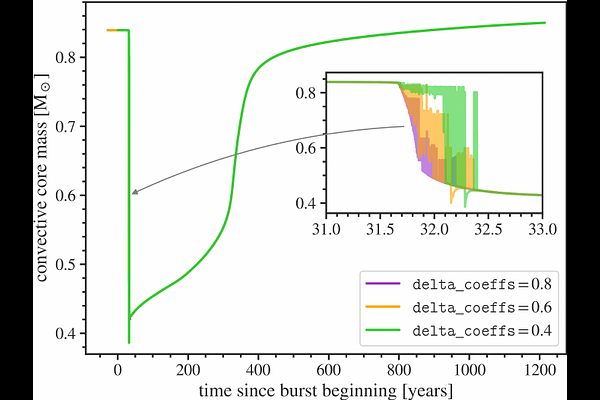
AbstractDuring star formation, objects may gain the majority of their final mass through regular and intense bursts of mass accretion. For bursts of the FU Orionis-type (FUor), accretion rates can climb to $10^{-3} \ \text{M}_\odot \text{yr}^{-1}$ during short windows of time, amounting to just a few percent of the main accretion phase. To study the occurrence of such events observationally, signatures of the current accretion bursts and tracers of recent bursts are crucial. We investigate the potential to identify accretion bursts in protostars and pre-main sequence stars of intermediate mass using asteroseismology. We use the stellar structure and evolution code MESA to evolve stellar models from the protostellar seed phase of $0.01 \ \text{M}_\odot$ and $1.5 \ \text{R}_\odot$ up to $4.0 \ \text{M}_\odot$ with a constant accretion rate of $10^{-6} \ \text{M}_\odot \text{yr}^{-1}$. A single accretion burst is initialized during the accretion phase. The stellar oscillation code GYRE is employed to compute the resulting asteroseismic properties of the models. Accretion bursts of up to $10^{-3} \ \text{M}_\odot \text{yr}^{-1}$ are sufficient to cause the convective cores of the models to recede, leaving behind a chemical trace which manifests itself in the form of quasi-periodic dips in the g-mode period spacing. This effect is strongest during the outburst, but also lingers for up to 475 years before the convective core is re-established and the dips are gone. Our experiment shows that a single accretion burst leaves an imprint in the deep interiors of protostars and pre-MS stars of intermediate mass, and that this imprint can be captured with asteroseismology. Our results are most conclusive for burst magnitudes greater than $1\times10^{-4} \ \text{M}_\odot \text{yr}^{-1}$, corresponding to FUor-type bursts.