A Kiloparsec-Scale Stellar Cavity in the Center of Abell402-BCG May be Caused by Dynamic Interactions with an Ultramassive Black Hole

A Kiloparsec-Scale Stellar Cavity in the Center of Abell402-BCG May be Caused by Dynamic Interactions with an Ultramassive Black Hole
Michael McDonald, Gourav Khullar, David Lagattuta, Guillaume Mahler, Shashank Dattathri, Jose M. Diego, Alastair C. Edge, Benjamin Floyd, Michael D. Gladders, Scott A. Hughes, Mathilde Jauzac, Nader Khonji, Gavin Leroy, Richard Massey, Mireia Montes, Priyamvada Natarajan, Michael Reefe, Keren Sharon, Frank van den Bosch, Stepane Werner, Adi Zitrin
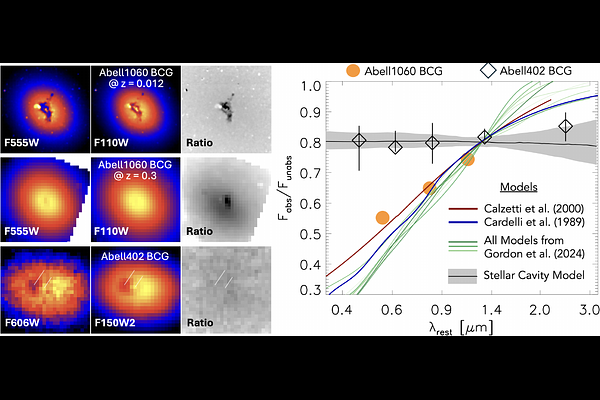
AbstractWe present new observations from JWST NIRCam that reveal a striking kpc-wide cavity in the stellar distribution of the central galaxy in the cluster Abell402. Supporting data from HST allow us to rule out extinction due to dust as an explanation and, instead, suggest that this is a localized depression in the stellar density field corresponding to ~2x10^9 Msun in missing stars within a volume of 0.5kpc^3. On larger scales, both the JWST and HST data show evidence for a 2.2kpc flattened core in the stellar distribution (on which the smaller-scale cavity is superimposed), which implies the presence of a central ultra-massive black hole with M_BH = 6 +/- 4 x10^10 Msun. We report evidence for a mid-IR-bright point source at one edge of the cavity, suggesting that this black hole is actively accreting. MUSE spectroscopy reveal that this source is a LINER AGN and that there is a second candidate AGN on the opposite side of the cavity with a relative velocity of 370km/s -- if real, this implies the presence of a kpc-separation dual AGN with a total binary mass of 6 +/- 2 x10^10 Msun, which would make this the most massive binary black hole system discovered to date. We propose that this unique stellar cavity is the result of a short-lived dynamical interaction between at least one supermassive black hole and the background stellar density field, caused either by three-body scattering during binary hardening or the induction of a dipole instability in the stellar density field.