The fate of Mercury's ejected mantle

The fate of Mercury's ejected mantle
Tuhin Ghosh, Mark Wyatt, Alan P. Jackson, Oliver Shorttle, Maximilian Sommer
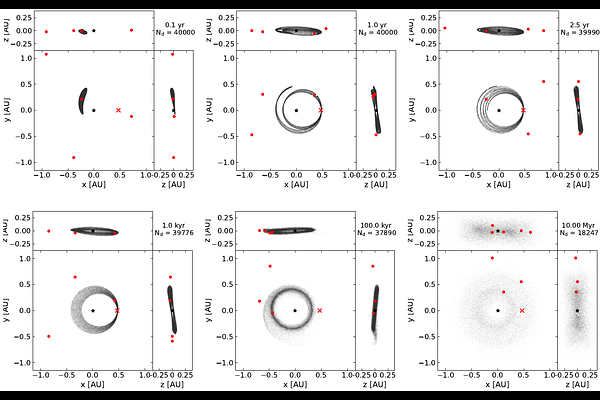
AbstractMercury's unusually high core mass fraction, inferred from its high bulk density, remains difficult to explain. Mantle stripping by a giant impact provides a plausible origin, but without efficient removal, the ejected debris remains on Mercury-crossing orbits and later gets re-accreted. Here, we show that re-accretion of impact debris onto Mercury is inefficient, making a giant-impact origin plausible. We combine N-body simulations of giant-impact ejecta with a collisional evolution model and consideration of processes acting on small dust. We find that, when the ejecta are dominated by large, several hundred km-sized non-vaporized fragments, the debris disk remains optically thin and the collisional cascade is truncated near the radiation-pressure blowout limit, where micron-sized grains are removed. In contrast, if vaporized, the ejecta recondense into mm to cm-sized droplets and form an optically thick disk, in which radiation pressure cannot efficiently truncate the cascade. The debris can then be ground down to nanometre-sized grains, where collisions become predominantly non-fragmenting and dissipative rather than destructive. Subsequent inelastic collisions damp the eccentricities and inclinations of the nanodust, producing a geometrically thin disk whose lifetime is governed by removal through exposed surface layers, where grains acquire large charge-to-mass ratios through solar UV radiation and are rapidly removed by electromagnetic forces. In either scenario, collisional evolution strongly reduces the re-accretion of debris and alleviates a key difficulty for the giant-impact origin of Mercury's large core. More broadly, highly energetic giant impacts in the inner regions of planetary systems may lead to short-lived populations of nanometre-sized dust.