The dust attenuation scaling relation in the TNG50 simulation

The dust attenuation scaling relation in the TNG50 simulation
Pedro Cataldi, XianZhong Zheng, Antonios Katsianis, Sebastian Schulz, Man Qiao, Jianbo Qin, Zongfei Lyu
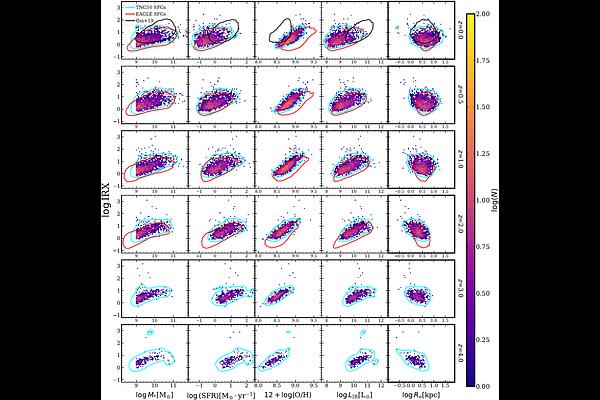
AbstractThe infrared excess (IRX = L_IR / L_UV) of star-forming galaxies (SFGs) follows a tight scaling relation with star formation rate, gas-phase metallicity, and size up to z ~ 3, providing a key benchmark for galaxy formation models. We test whether TNG50 SFGs, post-processed with the radiative transfer code SKIRT, reproduce the universal IRX relation - linking IRX to metallicity, infrared luminosity, size, and inclination - and identify the origin of any offsets. We analyse 7280 TNG50-SFGs across 0 <= z <= 4, comparing their predicted IRX relations with observations and the EAGLE simulation. We test different dust-to-metal (DTM) ratios and dust compositions, recalibrate galaxy properties to observed scaling relations, and decompose the offsets into individual parameter contributions. TNG50-SFGs match the universal IRX relation closely at 0.5 <= z <= 1, but lie above it at z = 0 (+0.5 dex) and below it at z >= 2 (-0.25 dex). They follow a relation of the same functional form, with a shallower, metallicity-independent L_IR slope. At z ~ 0, TNG50-SFGs are ~1 dex fainter in L_IR than the local calibration sample, requiring extrapolation; at fixed stellar mass and L_IR, simulated and observed IRX agree within 0.04 dex. At z >= 2, TNG50-SFGs are less obscured than predicted, an offset largely removed by lowering their metallicities by ~0.2 dex. Varying the DTM ratio and dust type shifts the offset normalisation without resolving its redshift evolution: a redshift-dependent DTM ratio helps at high z, but not at z = 0. Resolving the low-z discrepancy requires both improved dust models and observational constraints on IR-faint galaxies.