Bridging the gap between SLSNe and SE-SNe. Multi-wavelength analysis of the SLSN-Ib SN 2024jlc

Bridging the gap between SLSNe and SE-SNe. Multi-wavelength analysis of the SLSN-Ib SN 2024jlc
A. Simongini, F. Acero, M. Imbrogno, J. L. Wise, J. Sollerman, S. Schulze, N. Paul M. Kuin, T. X. Chen, C. Fremling, A. Gangopadhyay, M. M. Kasliwal, R. R. Laher, Z. McGrath, D. A. Perley, J. N. Purdum, N. Rehemtulla, R. M. Rich, R. Riddle
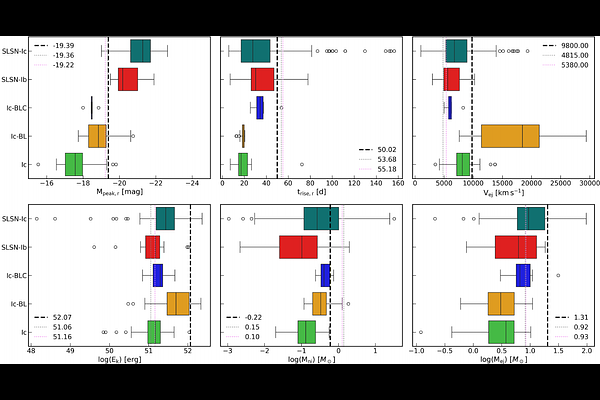
AbstractThe Type I super-luminous supernova SN~2024jlc (ZTF24aapadbb) exploded on the 25th of May 2024 at $z = 0.039$. Being the closest supernova of this class discovered in recent years and one of the closest ever, represented a rare opportunity to study in detail this type of objects. We performed a multi-wavelength analysis, spanning ten orders of magnitude in frequency, including optical/UV photometry and spectroscopy, soft and hard X-rays, and high-energy $γ$-rays. We characterized the event as a slow-evolving and He-rich supernova, with one of the lowest peak luminosities reported for a super-luminous event $M_g\sim-19.37$ mag, and a light curve evolution compatible with both circumstellar interaction and magnetar spin-down models, with noticeable contribution from $^{56}$Ni decay. No significant excess was found in the soft and hard X-ray bands, for which we provide upper-limits on the flux. Additionally, we analyzed two years of \textit{Fermi}-LAT data, from which we report an intriguing hint of a $γ$-ray signal at the $\sim 3.6 σ$ level, although no firm detection can be claimed. The gamma to optical efficiency ratio, $η= 0.38$, is suggestive of the presence of a central-engine scenario, similar to SN~2017egm. Our analysis suggests that SN~2024jlc could bridge the gap between SLSNe and classical stripped-envelope supernovae. While still poorly populated, this bridge could consist of all SLSN-Ib supernovae, with the key difference residing in the powering mechanism.