Energy Deposition by Galactic Cosmic Rays and Implications for Ozone Chemistry

Energy Deposition by Galactic Cosmic Rays and Implications for Ozone Chemistry
Luiz Augusto Stuani Pereia, Rita de Cássia dos Anjos
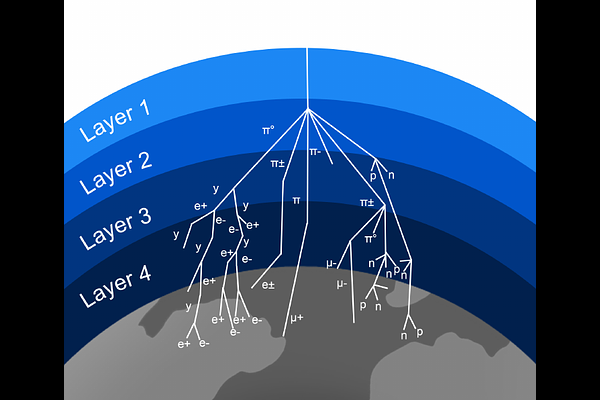
AbstractWe present a Monte Carlo study of galactic cosmic-ray (GCR) energy deposition and its implications for stratospheric chemistry, performed with the Geant4 toolkit. Primary nuclei (protons, $α$, CNO, and Si) were propagated through an atmosphere modeled from 0 to 120~g~cm$^{-2}$, considering both Polar ($R_{\mathrm{c}}=0.1$~GV) and Equatorial ($R_{\mathrm{c}}=15$~GV) geomagnetic cutoff conditions. The simulations resolve the variation of energy deposition with altitude for primary and secondary particles, revealing that $\sim$~96\% of the stratospheric energy budget arises from cascade secondaries within the 15--35~km domain. By converting layer-resolved energy deposition into ion pair production rates, we quantify the resulting formation of odd nitrogen (NO$_{\rm x}$) and odd hydrogen (HO$_{\rm x}$) radicals, which catalyze the destruction of ozone. The modeled production rates peak between 18 and 22~km altitude, leading to an estimated fractional ozone decrease of order $10^{-3}$--$10^{-2}$ under average GCR fluxes, consistent with observed background modulation over the solar cycle. These results establish a physically consistent link between cosmic-ray induced energy deposition and ozone chemistry, providing a benchmark framework for coupling high-energy particle transport to atmospheric photochemical models.