A nearby pulsar J1951+2837 observed by the LPA and FAST

A nearby pulsar J1951+2837 observed by the LPA and FAST
T. V. Smirnova, D. J. Zhou, M. A. Kitaeva, S. A. Andrianov, C. Wang, P. F. Wang, J. L. Han, S. A. Tyul'bashev
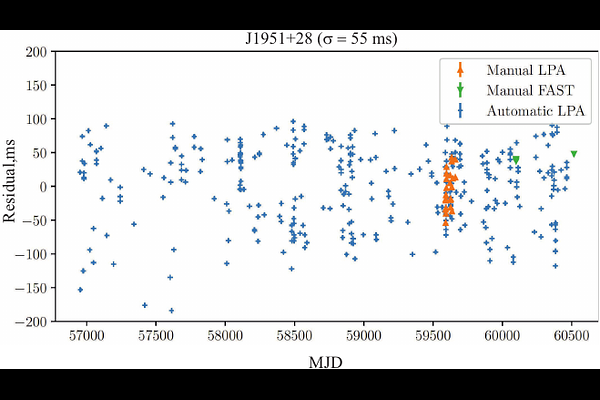
AbstractPSR J1951+2837 is a nearby pulsar with a period of 7.334 s and dispersion measure of DM = 2.9 $\pm$ 0.6 pc cm$^{-3}$, located about 200 or 300 pc from the Sun. It occasionally radiates bright pulses and has been observed by the Large Phased Array (LPA) radio telescope at 110 MHz and by the Five-hundred-meter Aperture Spherical radio Telescope (FAST) at 1250 MHz. We detected only 343 pulses in 228 LPA observation sessions and 5 bright pulses in two FAST sessions. Based on the times of arrival (TOAs) of these bright pulses, we determined the coherent timing solution for this pulsar at a frequency of 110 MHz. Based on flux densities (S) of these bright pulses at two frequencies ($ν$), we found that it is probably one of the known pulsars with the lowest luminosities to date, with a spectral index of about $α$ = (2.5 - 3.2) for S $\sim ν^{-α}$.