The Between-Round Decision in Autonomous Research: An LLM Controller That Reads the Whole Trajectory

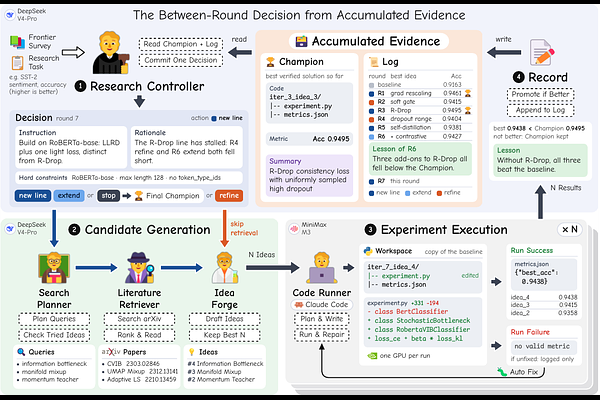
The Between-Round Decision in Autonomous Research: An LLM Controller That Reads the Whole Trajectory
Caoxin Wang, Shengkai Gan, Xiang Hu, Lili Pan
AbstractExecuting an idea often changes how promising it looks, so the next step in autonomous research should rest on results, not on proposals. After each round of experiments, the system must decide whether to refine the best solution or start a new direction, which solution to build from, and what goal to set. We call this the between-round decision. Existing systems wrap it in machinery such as rules, scores, search trees, and schedules; where an LLM makes it, what the LLM needs to read is left open. We ask whether an LLM can make this decision from accumulated evidence, without a search structure around it, and how much of that evidence it needs to read. We present BRED (Between-Round Evidence-based Decision), an LLM-based controller that maintains the best verified solution so far (the Champion) and a log of past rounds, and makes one decision per round. On three widely used research-agent benchmark tasks, BRED improves on the task baselines by 4.80% in MAE on ETTh1 (to 0.4172) and by 3.44 and 3.43 points of accuracy on SST-2 (to 95.07%) and CIFAR-100 (to 84.63%), ahead of the published results. When the controller does not read the accumulated evidence, the same loop gains less: with no history it reaches 0.4299 on ETTh1 and 83.71% on CIFAR-100, whereas the full controller's MAE is 2.95% lower and its accuracy 0.92 points higher. On a new task, speech-based depression detection under a leakage-free protocol, it reaches a macro-F1 of 0.6164 on seeds held out from selection, 5.5 points above its baseline and 4.0 above the strongest published system. Code is available at https://github.com/learninginvision/BRED.