Stars with Plumbing Issues: The Formation of Collimated Outflows on Common-Envelope Simulations and Comparison to Water Fountains Observations

Stars with Plumbing Issues: The Formation of Collimated Outflows on Common-Envelope Simulations and Comparison to Water Fountains Observations
Sarah V. Borges, Philip Chang
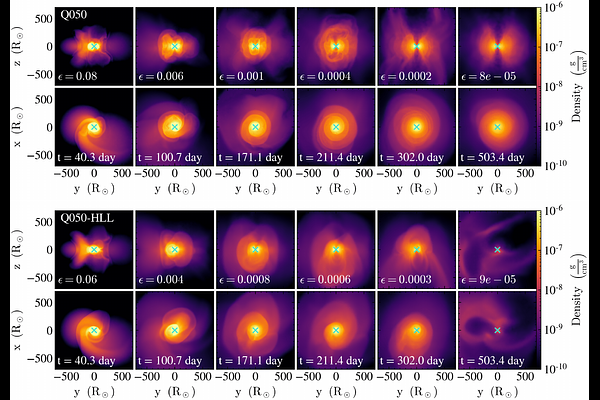
AbstractCommon-envelope evolution (CEE) is one of the biggest open questions in binary stellar evolution, despite being the main channel for the formation of close binaries. One of the main reasons CEE is difficult to model is the lack of direct observations that could constrain numerical simulations. One exception is luminous red novae, which are thought to represent CEEs that end in mergers. Unfortunately, there are no confirmed direct detections of ongoing events that result in the survival of a close binary, and we must rely on observations of post-CEE systems. Among these, planetary nebulae (PNe) are particularly important because their morphologies can probe how the envelope is ejected. However, post-CEE PNe do not reflect the ejected envelope in its pristine form, as winds from the central core also affect their morphology. In this context, Water Fountains (WFs), a class of objects proposed to form during CEE, provide an ideal comparison. They are identified by their collimated water masers, and most are still in the post-AGB phase. As such, WFs provide some of the best observational constraints for simulations, since they likely capture a snapshot of the envelope ejection while it is still happening. In this paper, we show that the formation of a circumbinary disk with collimated outflows surrounding the central binary arises naturally from hydrodynamical simulations of CEE, and that their morphology and kinematics are consistent with observations of WFs. We also present insights into how the properties of WFs may provide clues to understanding how CEE proceeds and help guide future simulations.