Field-Level Inference from Galaxies: BAO Reconstruction

Field-Level Inference from Galaxies: BAO Reconstruction
Adrian E. Bayer, Liam Parker, David Valcin, Shi-Fan Chen, Chirag Modi, Uros Seljak
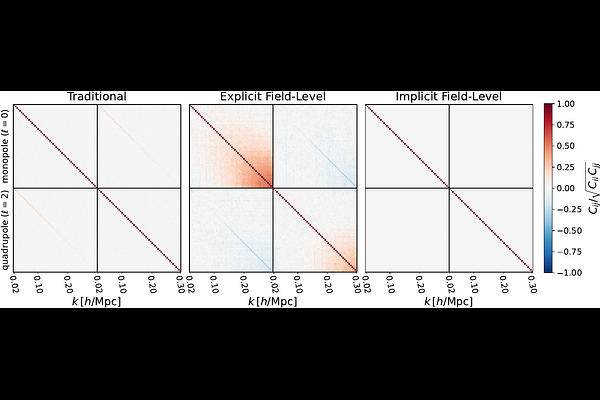
AbstractBaryon acoustic oscillations (BAO) underpin the key cosmological results from modern spectroscopic galaxy surveys, but nonlinear gravitational evolution limits the precision achievable with traditional analysis methods. To overcome this, we develop field-level inference for BAO, first reconstructing the initial linear density field and then fitting the BAO signal therein. We benchmark three reconstruction methods: (i) traditional reconstruction based on the Zel'dovich approximation, (ii) explicit field-level inference using differentiable forward modeling with hybrid effective field theory, and (iii) implicit field-level inference using a convolutional neural network to augment traditional reconstruction. Using DESI-like Luminous Red Galaxy (LRG) and Bright Galaxy Survey (BGS) catalogs, we find that field-level approaches significantly sharpen the BAO feature relative to traditional reconstruction. For LRGs, explicit field-level inference improves constraints on the BAO scale parameters ($α_{\rm iso}, α_{\rm ap}$) by 26%, while implicit inference improves constraints by 35%, corresponding to a 2.4$\times$ improvement in figure of merit. For the higher-density, lower-redshift BGS sample, field-level inference enables information extraction from smaller scales, yielding an improvement in constraints of up to 46%, corresponding to a 3.2$\times$ improvement in figure of merit. Crucially, we address longstanding concerns regarding the robustness of field-level reconstruction by leveraging 1,000 mock realizations to perform extensive coverage tests. Our results are both unbiased and statistically well-calibrated, maintaining nominal coverage even when using tight simulation-informed priors and under model misspecification.