Interferometric Images of the Starspot Evolution of $ζ$ Andromedae

Interferometric Images of the Starspot Evolution of $ζ$ Andromedae
Rachael M. Roettenbacher, John D. Monnier, Heidi Korhonen, Gregory W. Henry, Cliff Kotnik, Joshua Pepper, Bálint Seli, Krisztián Vida, Attila Bódi, Borbála Cseh, Géza Csörnyei, Máté Krezinger, Réka Könyves-Tóth, Levente Kriskovics, Krisztián Sárneczky, Ádám Sódor, Róbert Szakáts, Stefan Kraus, Narsireddy Anugu, Claire L. Davies, Tyler Gardner, Cyprien Lanthermann, Gail H. Schaefer, Benjamin R. Setterholm
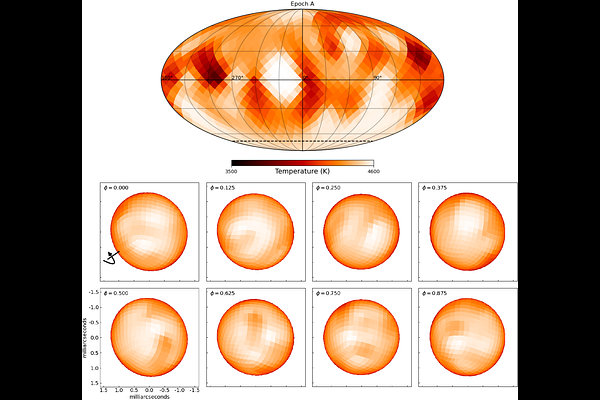
AbstractThe evolution of starspots of the giant primaries of RS CVn systems is typically detected indirectly with photometric and spectroscopic monitoring. These observations suggest slowly-evolving stellar surfaces and can constrain differential rotation as starspots move with respect to one another. However, starspot latitudes are difficult to constrain without resolved images of the stellar surfaces from which the unambiguous locations of starspots are determined. We imaged the active RS CVn primary $ζ$ And with the 330-m-baseline Center for High Angular Resolution Astronomy Array for three epochs over approximately six rotations of the star. The resultant images show a more complicated picture of stellar activity than expected from the contemporaneous photometry and earlier Doppler images. The spot structures change on the timescale of rotation, making differential rotation difficult to study. Our observations show changes in the polar spot, growing over time. We do not detect the secondary star in the interferometric data, though the observations are sensitive to the predicted 0.75 $M_\odot$ main-sequence star, and we suggest the companion may be a white dwarf.