Multi-year forecasting of F10.7 and F30 solar radio flux using an adaptive Kalman filter and hemispheric solar activity

Multi-year forecasting of F10.7 and F30 solar radio flux using an adaptive Kalman filter and hemispheric solar activity
Zaina Abu-Shaar, Tatiana Podladchikova, Astrid M. Veronig, Stefan J. Hofmeister, Anatoly Petrukovich
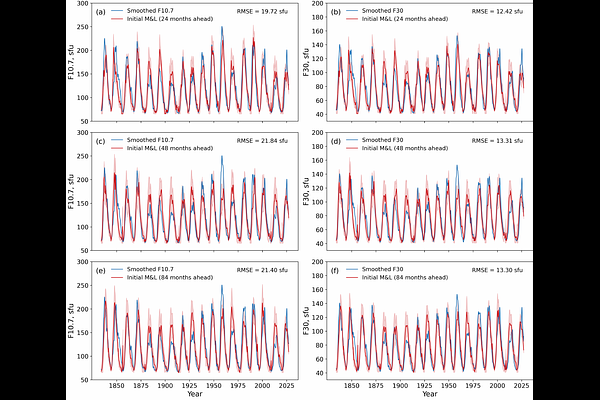
AbstractThe F10.7 and F30 radio flux indices drive thermospheric and radiation-environment models, and long-term predictions are needed for satellite mission planning, orbital-lifetime estimates, and re-entry assessments. We develop multi-year predictions of both indices for lead times of 1 to 84 months using three complementary contributions. First, we apply the McNish-Lincoln (M&L) method and demonstrate its predictive skill over multi-year horizons, with RMSE of 11-22 sfu for F10.7 and 7-14 sfu for F30. RMSE largely stabilizes after roughly 36 months, indicating near-constant forecast skill over the seven-year horizon. Accuracy also depends strongly on the solar-cycle phase at which the forecast is issued, with the most favorable starting intervals occurring progressively earlier in the cycle for longer lead times. Second, we update the initial predictions using an adaptive Kalman filter with noise statistics identification, which assimilates the latest monthly observations to reconstruct the current smoothed flux, remove the delay introduced by centered smoothing, and improve solar-cycle state estimation, reducing forecast errors by up to 70%. Third, we introduce synthetic hemispheric components of solar radio flux to account for the separate evolution of the northern and southern hemispheres, and incorporate them into a hemispheric M&L formulation. Compared with the initial M&L predictions, it reduces RMSE by up to 55% for F10.7 and 58% for F30, showing that hemispheric asymmetry contains predictive information lost in the full-disk index. These results extend solar-cycle forecasting to multi-year timescales relevant for long-term space-weather applications and operational planning.