IRIS: Deciphering Spectral-Line Imagery of the Galactic Center by Machine-Learning on Simulations

IRIS: Deciphering Spectral-Line Imagery of the Galactic Center by Machine-Learning on Simulations
B. L. DuBois, Cara Battersby, Jonah C. Baade, Dani R. Lipman, H Perry Hatchfield, Jack Sullivan, Russell Bentley, Stefan Reissl, Ralf S. Klessen, Victor F. Ksoll, Mattia C. Sormani, Zi-Xuan Feng, Adam Ginsburg, Robin Tress
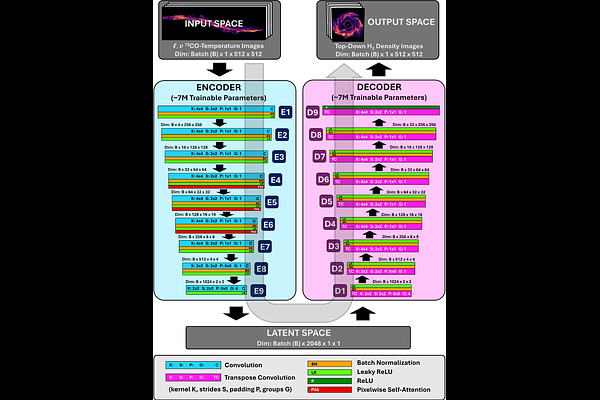
AbstractIn understanding the 3D structure of the Milky Way's Central Molecular Zone (CMZ), we are limited by our edge-on perspective. Towards addressing this problem, we introduce Imagery Reversion Informed by Simulation (IRIS). IRIS is a novel machine-learning code base featuring a deep convolutional neural network (CNN), which we have designed to translate edge-on observations of our Milky Way Galaxy into top-down images by training on data generated from AREPO galaxy simulations and synthetic observations of those simulations. We develop a large custom dataset on which we train our bespoke model, and then test the trained model on synthetic data to probe the potential of this machine-learning method, which we call supervised reversion. We then apply our trained model to real observations from the SEDIGISM 13CO(2-1) survey, yielding new top-down views of our CMZ. Though our SEDIGISM reversions are not fully consistent across model training runs, we posit that this lack of convergence can be alleviated by expansion of the training dataset. We argue that these results represent a strong proof-of-concept for the use of supervised reversion to decipher our CMZ's 3D structure. Crucial in generating our training dataset's 100k synthetic observations, we introduce IRIS Synthetic Observation (IRIS-SO), a new GPU-accelerated and fully differentiable code implemented in PyTorch for the non-LTE synthetic observation of spectral lines and dust. We find that IRIS-SO provides up to 10,000x speedups in comparison to the synthetic-observation code RADMC-3D. We release all the IRIS code open-source at https://github.com/bldubois/IRIS.