Probabilistic mapping between multiparticle production variables and the depth of maximum in proton-induced extensive air showers

Probabilistic mapping between multiparticle production variables and the depth of maximum in proton-induced extensive air showers
Lorenzo Cazon, Ruben Conceição, Miguel Alexandre Martins, Felix Riehn
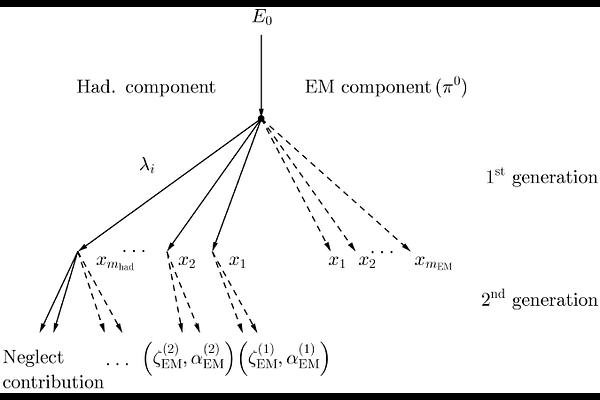
AbstractThe interaction of ultra-high-energy cosmic rays with air nuclei triggers extensive air showers that reach their maximal energy deposition at the atmospheric depth $X_{\max}$. The distribution of this shower observable encodes information about the proton-air cross-section via fluctuations of the primary interaction point, $X_1$, and hadron production through $\Delta X_{\max} \equiv X_{\max} - X_1$. We introduce new multiparticle production variables, $\alpha_{\textrm{had}}$, $\zeta_{\textrm{had}}$, and $\zeta_{\mathrm{EM}}$, built from the energy spectra of secondaries in the primary interaction. Their linear combination, $\xi$, predicts over $50 \%$ of the fluctuations in $\Delta X_{\max}$. Moreover, we build a probabilistic mapping based on the causal connection between $\xi$ and $\Delta X_{\max}$ that enables model-independent predictions of $X_{\max}$ moments with biases below $3\,\mathrm{g\,cm^{-2}}$. Therefore, measurements of the distribution of $X_{\max}$ allow a data-driven probing of secondary hadron spectra from the cosmic-ray-air interaction, in proton-induced showers. The distributions of the new multiparticle production variables can be measured in rapidity regions accessible to current accelerators and are strongly dependent on the hadronic interaction model in the kinematic regions exclusive to ultra-high-energy cosmic rays.