A Census of the 200 Most Massive Galaxies Spectroscopically Observed with JWST at zspec $\sim$3-15

A Census of the 200 Most Massive Galaxies Spectroscopically Observed with JWST at zspec $\sim$3-15
Mengyuan Xiao, Pascal A. Oesch, Longji Bing, Rashmi Gottumukkala, Rui Marques-Chaves, Gabriel Brammer, Miroslava Dessauges-Zavadsky, David Elbaz, Songnan Qi, Anurag Amol Sawarkar, Manuel Aravena, Matthieu Béthermin, Rachel Bezanson, Rychard Bouwens, Caitlin Casey, Pieter van Dokkum, Andreas L. Faisst, Yoshinobu Fudamoto, Anna de Graaff, Olivier Ilbert, Garth Illingworth, Guilaine Lagache, Benjamin Magnelli, Jorryt Matthee, Yurina Nakazato, Daniel Schaerer, Sune Toft, Katherine E. Whitaker, Christina C. Williams
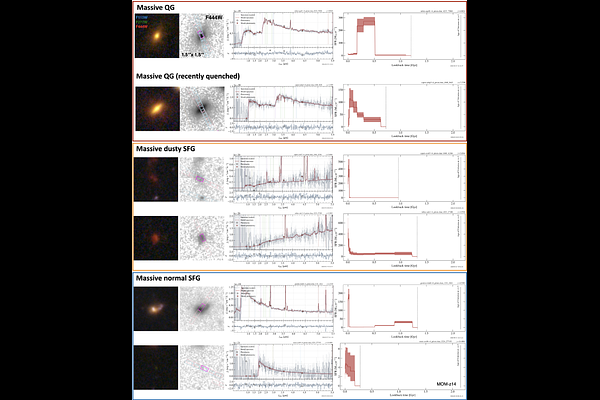
AbstractMassive galaxies provide strong tests of galaxy formation models, yet a comprehensive spectroscopic view of their properties and demographics in the early Universe has remained elusive. Here we present a JWST spectroscopic census of the 200 most massive galaxies at zspec~3-15, selected using an evolving stellar-mass threshold motivated by the halo mass function and anchored at log(Mstar)>10 at z~5. These galaxies represent the top 3% most massive systems among all publicly available prism observations. We derive their physical properties through joint SED fitting of spectroscopy and photometry, and construct a clean massive galaxy sample after removing LRDs and broad-line AGN contaminants. We find that the massive galaxy population evolves strongly with redshift: normal SFGs (Av<1 mag) dominate at z>~6, while dusty SFGs (Av>1 mag) and QGs become more common toward lower redshift. Dust attenuation decreases systematically toward higher redshift. We identify 29 massive QGs, including a population of recently quenched systems whose star formation declined rapidly within the past ~100 Myr. We further show that both the traditional UVJ and recently proposed (ugi)s selections suffer substantial inconsistency with the most massive galaxies at z>3, motivating a revised (ugi)s criterion calibrated using our spectroscopic sample. The inferred formation histories suggest at least two pathways toward quiescence: a dust-enriched pathway linking normal SFGs, dusty SFGs, and QGs, and a more direct pathway connecting normal SFGs and QGs. Massive normal SFGs appear to grow through both relatively gradual and rapid assembly modes. Together, these results suggest that rapid stellar-mass assembly, dust enrichment, and quenching were already shaping the evolutionary pathways of the most massive galaxies within the first billion years after the Big Bang.