JWST Reveals Two Overmassive Black Hole Candidates in Dwarf Galaxies at z $\approx$ 0.7: Pushing Black Hole Searches into the Dwarf-Galaxy Regime

JWST Reveals Two Overmassive Black Hole Candidates in Dwarf Galaxies at z $\approx$ 0.7: Pushing Black Hole Searches into the Dwarf-Galaxy Regime
E. Iani, P. Rinaldi, A. Torralba, J. Lyu, R. Navarro-Carrera, G. H. Rieke, F. Sun, C. Willott, Y. Zhu, A. Alonso-Herrero, M. Annunziatella, P. Bergamini, K. Caputi, M. Catone, L. Colina, R. Cooper, L. Costantin, A. Crespo Gómez, G. Desprez, C. Di Cesare, M. J. Hayes, I. Jermann, G. Kotiwale, I. Kramarenko, D. Langeroodi, S. Mascia, J. Matthee, J. Melinder, A. Muzzin, B. Navarrete, G. Noirot, G. Östlin, F. Pacucci, G. Rodighiero, M. Sawicki, Y. Sun, Z. Wu, G. Yang
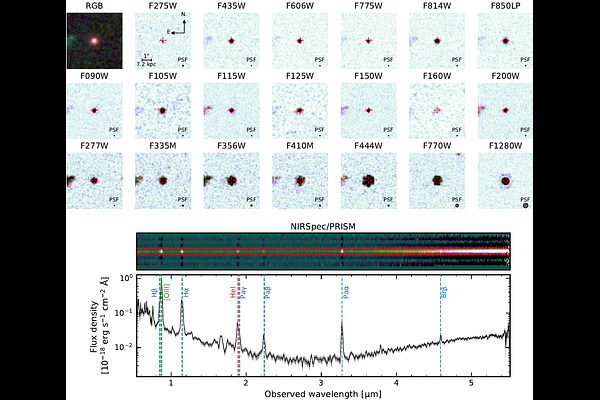
AbstractWe report the discovery and characterization of two compact galaxies, Pelias and Neleus, at z ~ 0.71 and z ~ 0.75, identified in MACS J0416.1-2403 and GOODS-North. Both exhibit unusual spectral energy distributions (SEDs), with very blue rest-frame UV-optical emission and a steep rise toward near- and mid-infrared wavelengths. JWST/NIRISS and JWST/NIRSpec spectroscopy show strong rest-frame optical lines ([O III] 4959,5007 and Halpha) with extreme equivalent widths (>= 1000 Angstrom), indicating young burst-dominated populations with low metallicities (Z ~ 0.1-0.4 Zsun), low dust attenuation (Av ~ 0.2 mag), and stellar masses of Mstar ~ 10^7 Msun. Nonetheless, JWST/MIRI photometry reveals a strong mid-infrared excess that cannot be explained by stellar populations or star-formation-heated dust alone, requiring a hot-dust component most naturally associated with a deeply embedded active galactic nucleus (AGN). SED modelling yields log10(Lbol [erg/s]) ~ 43.7-44.0, implying black hole masses of log10(MBH [Msun]) ~ 5.7-6.7 under the assumption of Eddington-limited accretion. Given the very low stellar masses of the hosts, this corresponds to black-hole-to-stellar mass ratios of about 6-60%, well above the extrapolation of local scaling relations. The lack of X-ray detections suggests that the accretion may be either heavily obscured or intrinsically X-ray weak. Their SEDs also resemble those of Blue Excess Hot Dust Obscured Galaxies and show the characteristic V-shaped continuum seen in Little Red Dots, although with the inflection occurring at redder wavelengths.