Architecture and Validation of the CRS F-Engine for the CHORD Radio Telescope

Architecture and Validation of the CRS F-Engine for the CHORD Radio Telescope
Ian Hendricksen, Jean-François Cliche, Matt Dobbs, Joshua Montgomery
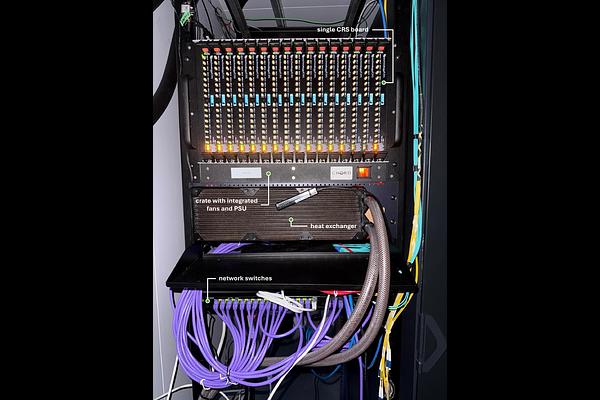
AbstractWe introduce the design of the t0.technology Control and Readout System (CRS) F-Engine that will be used for the Canadian Hydrogen Observatory and Radio transient Detector (CHORD), a new radio interferometer currently being commissioned at the Dominion Radio Astrophysical Observatory (DRAO) in Canada. The CRS F-Engine will directly digitize and channelize 1024 individual RF signals from the 512 dual-polarized dishes of the core array using an array of 128 CRS boards, a multi-purpose microwave readout platform using an AMD Zynq Ultrascale+ RF-System-on-Chip (RFSoC) architecture. The CRS supports the required analog and digital signal processing and is appropriately scalable, with rack-mountable crates each supporting up to 16 CRS boards, equipped with a backplane for distribution of power, common clock and time synchronization signals, and a full-mesh network for intra-crate data transmission. Implemented on the CRS boards is the chFPGA firmware which supports the digitization of 8 analog signals at 3.2 GSPS and channelizes them with a CASPER-based PFB/FFT into 8,192 frequency bins with ~195 kHz of resolution, which are then re-quantized into (4 + 4i) bits for data offload to an external X-Engine. chFPGA supports multiple post-channelization signal processing options through separate bitstream files for different applications, such as a 100 GbE packet assembler-transmitter for CHORD to feed channelized data to its external GPU-based X-Engine, as well as FPGA-based N^2 correlators, including a single-board (N = 8) correlator (the ``Pocket Correlator"), and a multi-board corner-turn engine coupled with a half-CRS crate (N = 64) correlator. We demonstrate the performance of chFPGA by injecting a wideband Gaussian noise source into a CRS board running the Pocket Correlator firmware, and find that recovered digitized timestream and channelized data are in excellent agreement with expectations.