Colour evolution in the radio afterglow of GRB 241025A

Colour evolution in the radio afterglow of GRB 241025A
S. Giarratana, O. S. Salafia, L. Nava, G. Ghirlanda, M. Giroletti, S. Antier, M. Pillas, T. Hussenot-Desenonges, A. Iskandar, M. Tanasan, G. Oganesyan, N. Di Lalla, N. Omodei
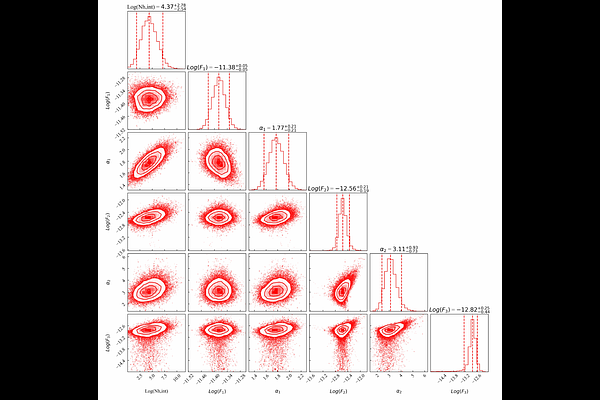
AbstractWe present the observing campaign of the afterglow of GRB241025A, a gamma-ray burst (GRB) whose prompt emission has been simultaneously detected by Swift, Einstein Probe, Fermi/GBM, SVOM, Konus-Wind and VZLUSAT-2 3U CubeSat. Our multi-wavelength campaign comprises radio, near-infrared, Optical and X-ray observations. The afterglow was clearly detected in all bands. We performed a semi-empirical fit of the data, showing that the afterglow behaviour can be reasonably reproduced by a single component, i.e. an ultra-relativistic shock. However, the results from the semi-empirical fit are inconsistent with the predicted evolution from the standard afterglow model in the slow cooling regime. Specifically, we found that at early times the synchrotron self-absorption frequency $ν_a$ should be at higher frequencies with respect to the ones sampled by our campaign, in order to explain the observed colour evolution in radio, namely the spectral evolution in time. To reconcile the prediction from the standard model with the observed data set, we fit the observations with a semi-analytical model, including a multiplicative factor $τ_{enh}$ to the optical depth which, in turn, artificially increases $ν_a$. We found that the radio colour evolution, together with the near-infrared, optical and X-ray emission, can be described reasonably well by a forward shock from a structured jet, provided that the optical depth in the shocked material is enhanced by a factor $τ_{enh}=500$. We suggest that such enhancement in the optical depth can result from a population of cold electrons in the downstream material, i.e. electrons that were not accelerated by Fermi I process at the shock front, in agreement with the theoretical expectations previously reported in the literature. Overall, our work underscores the importance of systematic, multi-frequency, multi-epoch radio follow-ups of these extreme events.