Low-Noise SiPM Light Readout and ASIC-Based Charge Readout of a Liquid Argon Time Projection Chamber for MeV Gamma-Ray Measurements

Low-Noise SiPM Light Readout and ASIC-Based Charge Readout of a Liquid Argon Time Projection Chamber for MeV Gamma-Ray Measurements
Satoshi Takashima, Hirokazu Odaka, Shota Arai, Kentaro Shirahama, Ryutaro Tatsumi, Hodaka Kawamura, Masashi Tanaka, Shintaro Arai, Tsuguo Aramaki, Aya Bamba, Lorenzo Fabris, Georgia Karagiorgi, Haruki Kuramoto, Jonathan LeyVa, John W. Mitchell, Aiko Miyamoto, Reshmi Mukherjee, Kaito Murakami, Azuki Nagao, Arathi Suraj, Sayana Takatsuka, Chihiro Watanabe, Shin Watanabe, Yutaro Yano, Kazushi Yawata, Hiroki Yoneda, Kohei Yorita, Jiancheng Zeng
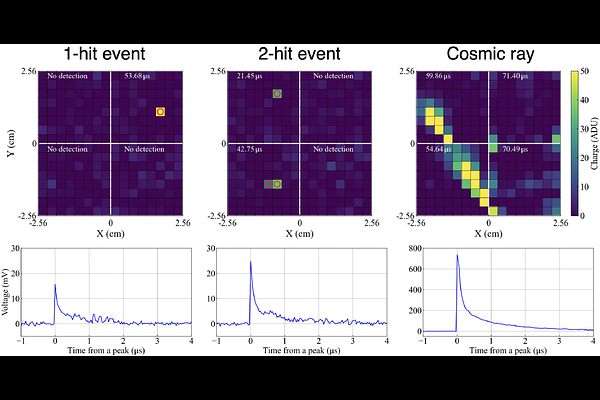
AbstractWe have developed a compact liquid argon time projection chamber (LArTPC), NanoGRAMS, as a technology demonstrator for the Gamma-Ray and AntiMatter Survey (GRAMS). LArTPCs have the potential to enable Compton cameras with unprecedented effective area in the MeV gamma-ray band. NanoGRAMS has an active volume of $5.12 \times 5.12 \times 10~\mathrm{cm^3}$ and is equipped with a low-noise scintillation and charge readout system. The scintillation light is detected by an array of 16 SiPMs ($6 \times 6~\mathrm{mm^2}$ each), whose signals are summed and amplified by a low-noise transimpedance amplifier operable at liquid argon temperature. Ionization electrons are read out with $3.2\,\mathrm{mm}$-pitch pixels and processed by VATA-SGD ASICs, with synchronization provided by an FPGA-based data acquisition system. We irradiated the detector with a $^{60}\mathrm{Co}$ source (1173 and $1332\,\mathrm{keV}$) and successfully detected both 1-hit and 2-hit events. The collected charge was converted to deposited energy using a phenomenological recombination model, and the detector response was evaluated with a Geant4-based Monte Carlo simulation. The reconstructed energy spectrum shows Compton edges at 963 and $1118\,keV$, consistent with the expected values. For 2-hit events, the sequence of interactions was identified, and the reconstructed back-projection image agrees with the source position. These results demonstrate the feasibility of NanoGRAMS as a Compton camera for MeV gamma-ray imaging spectroscopy.