Anticipatory Planning for Multimodal AI Agents

Anticipatory Planning for Multimodal AI Agents
Yongyuan Liang, Shijie Zhou, Yu Gu, Hao Tan, Gang Wu, Franck Dernoncourt, Jihyung Kil, Ryan A. Rossi, Ruiyi Zhang
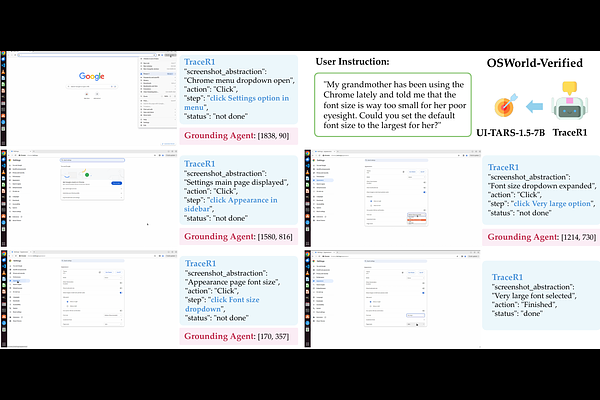
AbstractRecent advances in multimodal agents have improved computer-use interaction and tool-usage, yet most existing systems remain reactive, optimizing actions in isolation without reasoning about future states or long-term goals. This limits planning coherence and prevents agents from reliably solving high-level, multi-step tasks. We introduce TraceR1, a two-stage reinforcement learning framework that explicitly trains anticipatory reasoning by forecasting short-horizon trajectories before execution. The first stage performs trajectory-level reinforcement learning with rewards that enforce global consistency across predicted action sequences. The second stage applies grounded reinforcement fine-tuning, using execution feedback from frozen tool agents to refine step-level accuracy and executability. TraceR1 is evaluated across seven benchmarks, covering online computer-use, offline computer-use benchmarks, and multimodal tool-use reasoning tasks, where it achieves substantial improvements in planning stability, execution robustness, and generalization over reactive and single-stage baselines. These results show that anticipatory trajectory reasoning is a key principle for building multimodal agents that can reason, plan, and act effectively in complex real-world environments.