LSST Strong Lensing Systems Dark Matter Sensitivity Analysis with Neural Ratio Estimators

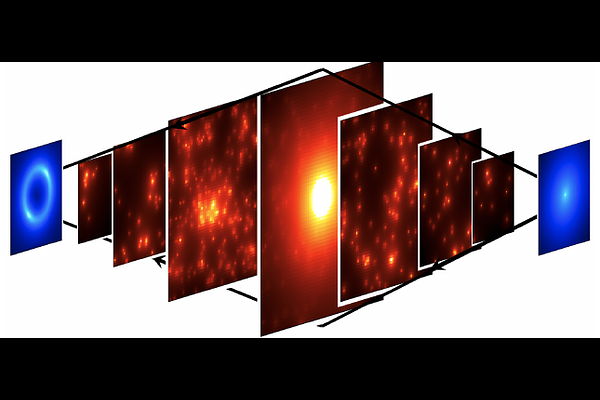
LSST Strong Lensing Systems Dark Matter Sensitivity Analysis with Neural Ratio Estimators
Andreas Filipp, Yashar Hezaveh, Laurence Perreault-Levasseur, Daniel Gilman, LSST Dark Energy Science Collaboration
AbstractStrong gravitational lensing offers a unique probe of dark matter (DM) on sub-galactic scales, where the abundance and distribution of low-mass halos are highly sensitive to the underlying properties of DM particles. In this work, we forecast LSST's sensitivity to DM substructure in galaxy-galaxy strong lenses using simulated samples and neural ratio estimators (NREs). Our simulations include both subhalos within the main deflector and line-of-sight (LOS) halos, with halo masses down to $\sim 10^7 M_\odot$ under the expected LSST ten-year survey imaging quality. We show that the constraining power on halo mass function (HMF) parameters improves significantly with sample size. Analyses based on a few hundred lenses yield broad posteriors comparable with other probes like the Ly-$α$ forest. By contrast, when combining 2500 lenses, $\approx 74\%$ and $\approx 36\%$ of the prior volume considered can be excluded at the $3σ$ and $5σ$ levels respectively, enabling statistically significant exclusions of non-$Λ$CDM scenarios. We further demonstrate that the sensitivity arises not only from the high-mass end of the HMF but also from low-mass halos: masking halos below $\log (m_{\rm halo}/M_\odot) \leq 7.5$ induces a measurable shift in the inferred posteriors. Finally, we find that LOS halos contribute significantly to the constraining power, with increasing importance of LOS halos at higher redshifts. While this analysis assumes perfect knowledge of the data-generating process and cannot be directly applied to data analysis, it quantifies constraints achievable with LSST alone and motivates the development of robust inference methods for real survey data.