Large scale mapping of [CI] and the [CI]-to-CO transition in $ρ$ Ophiuchus molecular cloud

Large scale mapping of [CI] and the [CI]-to-CO transition in $ρ$ Ophiuchus molecular cloud
Jifeng Xia, Ningyu Tang, Thomas G. Bisbas, Chen Wang, Gan Luo, Sihan Jiao, Xin Lv, Xuejian Jiang, Donghui Quan, Jinzeng Li, Paul F. Goldsmith, Gary A. Fuller, Di Li
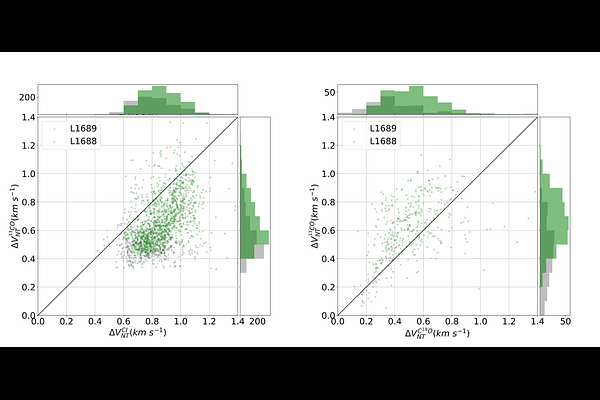
AbstractAtomic carbon ([CI]) is a key species in the carbon chemistry of the interstellar medium (ISM). Using the Submillimeter Wave Astronomy Satellite (SWAS), we conducted a [CI]($^3$P$_1$--$^3$P$_0$) 492 GHz survey covering approximately 4 deg$^2$ of the L1688 and L1689 regions in the $ρ$ Oph molecular cloud, achieving a spatial resolution of 4.25$\hbox{$^{\prime}$}$. The derived [CI] column densities, N([CI]), range from 4.85 $\times$ 10$^{14}$ cm$^{-2}$ to 6.29 $\times$ 10$^{17}$ cm$^{-2}$, corresponding to an abundance ratio N([CI])/N($H_2$) of 2.24$\times$ 10$^{-7}$ to 2.39$\times$ 10$^{-4}$, with a median value of 1.8$\times$ 10$^{-5}$. Combining observations with photodissociation region (PDR) modeling, we find that [CI] abundance varies less than CO in regions with UV intensity G$_0$ $> 16$ and N(H$_2$) $<$ 4.6 $\times$ 10$^{21}$ cm$^{-2}$, suggesting [CI] is a more reliable tracer of molecular hydrogen in low-density, high-radiation environments where the [CI]-to-CO transition occurs. Utilizing [CI] as direct H$_2$ tracer, the CO-dark gas fraction is estimated to be 0.43 , meaning that 43% of the total cloud mass will be missed by conventional calculation based on CO observations but can be calibrated by [CI] emission. The [CI] line widths are systematically broader than those of $^{13}$CO, possibly due to contributions from atomic carbon. These findings provide key insights into Galactic [CI] emission and the carbon cycle evolution in the interstellar medium. Future high-sensitivity [CI] ($^3$P$_1$--$^3$P$_0$) surveys with the Chinese Survey Space Telescope (CSST) will significantly advance our understanding of the carbon cycle evolution.