The Cluster Completeness Correction Calculator (C-4): A Neural-Network framework and pilot application to the LEGUS Survey of NGC 628

The Cluster Completeness Correction Calculator (C-4): A Neural-Network framework and pilot application to the LEGUS Survey of NGC 628
Jianling Tang, Kathryn Grasha, Tomasz Różański, Mark R. Krumholz, Alan Zhang
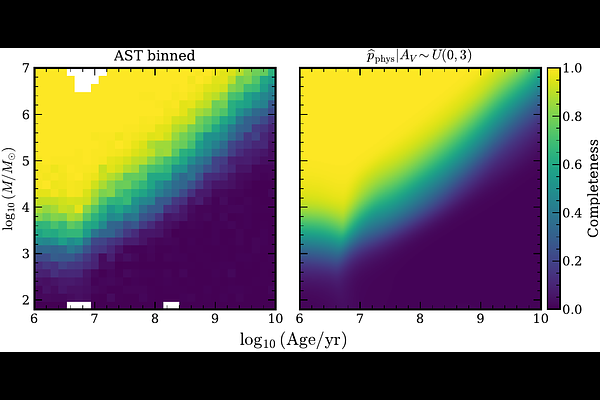
AbstractIntegrated-light star cluster catalogues in external galaxies are subject to complex, often poorly-characterised selection effects that can bias inferred cluster demographics and introduce significant uncertainties, limiting the physical parameter space accessible to analysis. To mitigate this problem, here we introduce the Cluster Completeness Correction Calculator (C-4): a new software tool to quantify and predict these effects in both physical and photometric parameter spaces. C-4 adds artificial star clusters to observed galaxy images, processes these images through the same detection and filtering steps used to construct the original cluster catalogue, and then trains multilayer perceptron neural networks to learn the resulting selection function. The trained neural networks provide continuous, differentiable completeness functions that can be used for direct completeness corrections or incorporated into forward models. We present a pilot application of C-4 to NGC~628, demonstrating that the learned selection operator is highly accurate and successfully captures the strongly non-separable dependence of completeness on mass, age, and extinction. Applying the completeness correction to NGC 628 extends the range of cluster demographic analyses by roughly an order of magnitude in both mass and age, and removes artificial flattening in the observed cluster mass and age distributions. These results establish neural-network-based completeness modelling as a powerful and general approach for recovering intrinsic cluster populations, and provide a scalable framework for modelling high-dimensional selection functions in resolved stellar population studies.