Far-ultraviolet flux distribution in Orion and its relation to stellar accretion

Far-ultraviolet flux distribution in Orion and its relation to stellar accretion
Rossella Anania, Andrew J. Winter, Miguel Vioque, Giovanni P. Rosotti, Giacomo Beccari, Giuseppe Lodato, Lorenzo A. Malanga, Lara Piscarreta, Alice Somigliana, Leonardo Testi, Claudia Toci
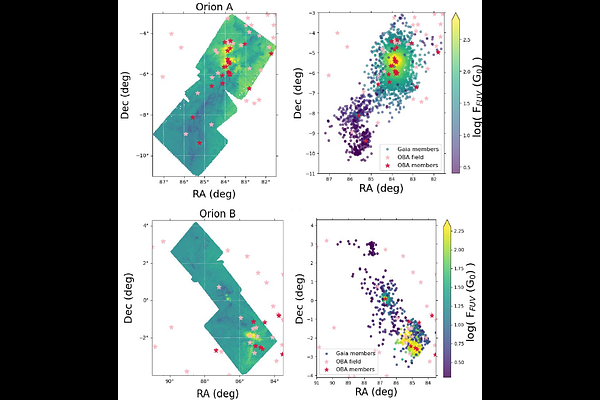
AbstractOrion is the closest region hosting active star formation and young OBA stars. Computing far-ultraviolet (FUV) fluxes at its stars is essential to connect stellar and protoplanetary disc properties to the environment. We (1) accurately estimated the FUV flux at a large sample of stars in Orion by statistically accounting for the uncertainty in parallax measurements, and (2) investigated the relation between stellar accretion and external FUV flux by comparing observations and disc evolution models. We selected a large stellar population in Orion, assigned sub-cluster memberships and used 2D dimensional sub-cluster geometry to infer 3D separations from OBA stars and compute the FUV flux at stellar positions. We studied the accretion luminosities Lacc inferred from Ha emission in Gaia XP spectra of Orion sources and determined their detection fraction as a function of age and FUV flux. We compared the results with population synthesis models of viscous discs experiencing external photoevaporation. We provided a publicly available table of FUV fluxes at ~8600 stars in Orion. Most of the stellar population is weakly irradiated <10^{2} G0, ~35% is intermediately irradiated 10^{2}-10^{4} G0, and ~5% has FUV fluxes >10^{4} G0. Gaia-based Lacc decreases with age, and Ha detection fraction declines more rapidly in regions with strong FUV fluxes than in regions exposed to weaker FUV fluxes, broadly consistent with the model. This may suggest that external photoevaporation efficiently depletes strongly FUV-irradiated accretion discs, but it is not sufficient to reliably confirm this conclusion. The provided tools for computing FUV fluxes at Orion stars will be essential for future observations aimed at assessing the role of external photoevaporation on discs. We encourage measurements of stellar and disc properties in Orion, covering FUV fluxes 1-10^5 G0.