Imprints of primordial magnetic fields on the late-time Universe

Imprints of primordial magnetic fields on the late-time Universe
Jennifer Schober, Molly Abramson, Sayan Mandal, Salome Mtchedlidze, Tina Kahniashvili
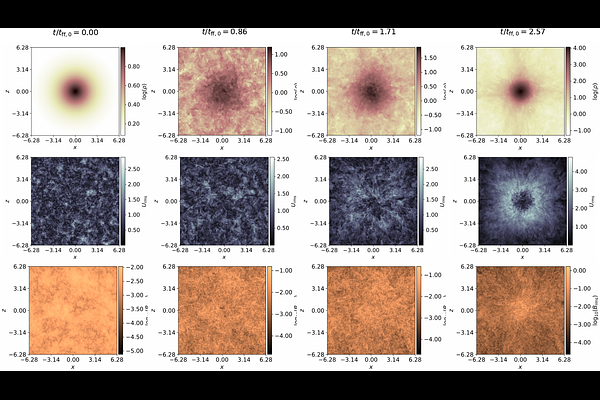
AbstractPrimordial magnetic fields (PMFs) generated in the early Universe may leave observable imprints in the present-day large-scale structure. However, it remains unclear on which spatial scales primordial signatures can survive the nonlinear processes accompanying structure formation. The aim of this study is to investigate the evolution of PMFs during gravitational collapse and to determine the spatial scales on which primordial signatures can persist. We perform a suite of high-resolution direct numerical simulations of self-gravitating, magnetized halos. By varying the viscosity, we probe different Reynolds-number regimes and follow the coupled evolution of gravitational collapse and magnetohydrodynamic turbulence. At sufficiently high Reynolds numbers, turbulence generated during collapse triggers the onset of a small-scale dynamo, which amplifies magnetic energy below the Jeans scale and modifies the magnetic energy spectrum significantly. Whether dynamo amplification dominates the magnetic field evolution is determined by the competition between the dynamo growth time and the free-fall time. Our results highlight the importance of resolving the Jeans scale and the associated turbulent inertial range in cosmological MHD simulations to accurately capture the interplay between gravitational compression and dynamo amplification and to assess which structures retain memory of primordial fields.