SN 2020bij and a Possible Slow-Rise High-Velocity Subclass of Type IIP Supernovae

SN 2020bij and a Possible Slow-Rise High-Velocity Subclass of Type IIP Supernovae
Sondos Mohsen-Tanev, Iair Arcavi, Shahar Bracha, K. Azalee Bostroem, Griffin Hosseinzadeh, Jesper Sollerman, Claudia P. Gutiérrez, Priscila J. Pessi, Joseph Anderson, Mariusz Gromadzki, Avishay Gal-Yam, Daichi Hiramatsu, Jamison Burke, Koichi Itagaki, Ting-Wan Chen, D. Andrew Howell, Curtis McCully, Megan Newsome, Estefania Padilla Gonzalez, Craig Pellegrino
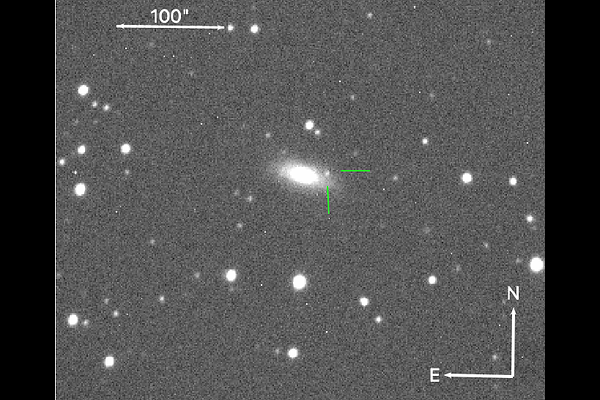
AbstractMapping how the explosion properties of Type II supernovae (SNe II) relate to the properties of their progenitors can provide strong constraints for understanding the final evolutionary stages of massive stars. Type IIP SNe, linked to the explosions of single red super-giant (RSG) stars, have recently been found to require some form of interaction with circumstellar material (CSM) to reproduce the rapid rise to the plateau often seen in their light curves. In this work, we present observations and analysis of the Type IIP SN 2020bij, characterized by a slow rise to its plateau as well as high expansion velocities. We identify four other SNe IIP from the literature (ASASSN-14kg, SN 2018fif, SN 2021yja and SN 2023axu) with similarly slowly rising light curves and find that they also show high expansion velocities. Using both analytical and numerical models, all five events can be explained with weak to no CSM interaction. We therefore propose that these events constitute a new subclass of Type IIP SNe which could be associated with relatively confined CSM. Early and dense photometric coverage of future SNe IIP together with early spectroscopic observations will further map this subclass and its physical properties. Understanding such rare events could be key to constraining the diversity of late-stage mass-loss in RSGs.