Unveiling SN 2022eyw: A Bright Member of the Type Iax Supernova Subclass

Unveiling SN 2022eyw: A Bright Member of the Type Iax Supernova Subclass
Hrishav Das, Devendra K. Sahu, Anirban Dutta, Mridweeka Singh, G. C. Anupama, Rishabh Singh Teja
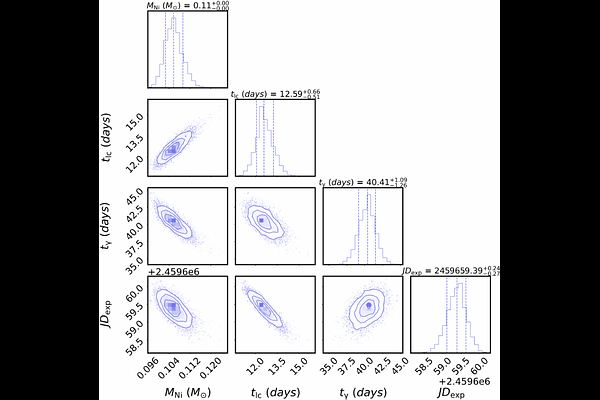
AbstractWe present comprehensive photometric and spectroscopic observations of Supernova (SN) 2022eyw, a luminous member of the Type Iax SN subclass. SN 2022eyw reached a peak absolute magnitude of $M_g = -17.80\pm0.15$ mag and exhibited a rise time of $\sim$15 days, placing it among the brighter Iax events. The bolometric light curve indicates a synthesized $^{56}$Ni mass of $0.120\pm0.003~\text{M}_{\odot}$, with an estimated ejecta mass of $0.79\pm0.09~\text{M}_{\odot}$ and kinetic energy of $0.19\times10^{51}$ erg. The spectral evolution from -8 to +110 days past maximum reveals features characteristic of bright Type Iax Supernovae, including a transition from Fe III to Fe II dominance, moderate expansion velocities, and a lack of strong C III absorption. TARDIS spectral modelling of the early-phase spectra indicates a well-mixed ejecta dominated by Fe-group elements. In addition, traces of unburnt carbon are detected, pointing to incomplete burning as expected in pure deflagration models. Late-time spectral evolution shows a blend of permitted and forbidden lines. Comparison with deflagration models suggests that SN 2022eyw originated from a partial deflagration of a Chandrasekhar-mass white dwarf, with explosion properties intermediate between the N3-def and N5-def models. These observations support pure deflagration of a CO white dwarf as a viable explosion mechanism for its luminous members.