Magnetic-Field-Induced Inspiral of Binaries with Circumbinary Disk: Black Hole and Protostellar Systems

Magnetic-Field-Induced Inspiral of Binaries with Circumbinary Disk: Black Hole and Protostellar Systems
Tomoaki Matsumoto, Kenta Hotokezaka, Kohei Inayoshi
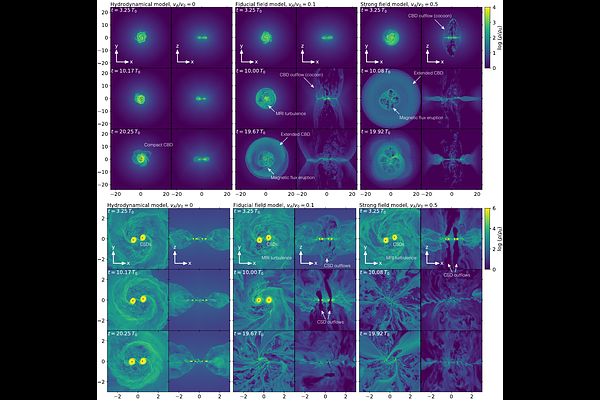
AbstractThe orbital decay of binary systems is a critical process for understanding the evolution of massive binary black holes (MBBHs) and binary star formation. Performing high-resolution three-dimensional magnetohydrodynamic (MHD) simulations, we investigate a binary system that accretes gas from an infalling envelope analogous to the collapse of molecular clouds in the context of binary star formation. Our simulations reveal the presence of outflows/jets launched from both the circumstellar (mini) disks and the circumbinary disk (CBD). The magneto-rotational instability is also excited within the CBD. These magnetic processes efficiently extract orbital angular momentum from the binary and thus drive orbital decay, while a purely hydrodynamical model exhibits orbital expansion. The decay rate reaches $\sim 0.3-0.7\%$ per orbital period, depending on the initial magnetic field strength. By appropriately scaling these numerical results, we propose a new mechanism for MBBHs mergers within a Hubble time, overcoming the bottlenecks encountered at separations near the final parsec scales. Additionally, we present a formation scenario for close twin binary star systems, emphasizing the significant role of magnetic processes in driving orbital evolution across various astrophysical systems.