Gotta Go Fast: A Generalization of the Escape Speed to Fluid-dynamical Explosions and Implications for Astrophysical Transients

Gotta Go Fast: A Generalization of the Escape Speed to Fluid-dynamical Explosions and Implications for Astrophysical Transients
Daniel A. Paradiso, Eric R. Coughlin
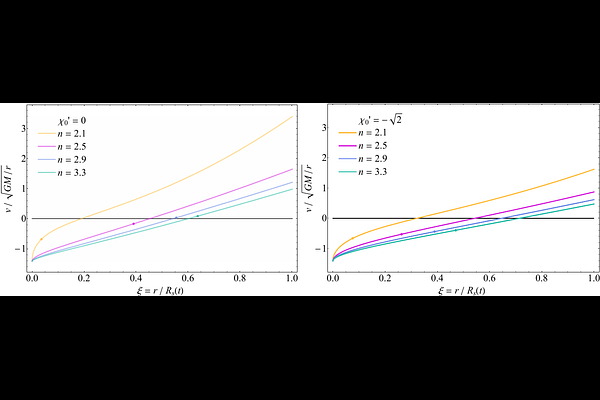
AbstractA star's ability to explode in a core-collapse supernova is correlated with its density profile, $\rho(r)$, such that compact stars with shallow density profiles preferentially ``fail'' and produce black holes. This correlation can be understood from a mass perspective, as shallower density profiles enclose $\sim 3M_{\odot}$ (i.e., the maximum neutron-star mass) at relatively small radii, but could also be due to the fact that a shockwave (driving the explosion) inevitably stalls if the density profile into which it propagates is shallower than $\rho(r) \propto r^{-2}$. Here we show that this condition -- the density profile being steeper than $\rho \propto r^{-2}$ -- is necessary, but not sufficient, for generating a strong explosion. In particular, we find solutions to the fluid equations that describe a shockwave propagating at a fixed fraction of the local freefall speed into a temporally evolving, infalling medium, the density profile of which scales as $\rho \propto r^{-n}$ at large radii. The speed of the shock diverges as $n\rightarrow 2$ and declines (eventually to below the Keplerian escape speed) as $n$ increases, while the total energy contained in the explosion approaches zero as the shock recedes to large distances. These solutions therefore represent fluid-dynamical analogs of marginally bound orbits, and yield the ``shock escape speed'' as a function of the density profile. We also suggest that stellar explodability is correlated with the power-law index of the density at $\sim10^9$ cm, where the neutrino diffusion time equals the local dynamical time for most massive stars, which agrees with supernova simulations.