You can't see me: super-Eddington growth hindering X-ray detection in high-z broad-line AGNs

You can't see me: super-Eddington growth hindering X-ray detection in high-z broad-line AGNs
Alessandro Trinca, Alessandro Lupi, Francesco Haardt, Piero Madau
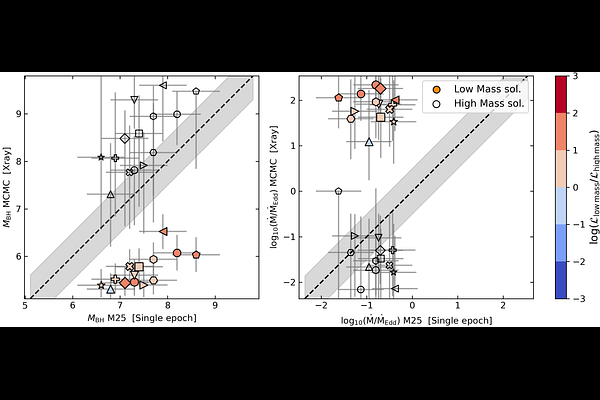
AbstractWe revisit black hole mass estimates for high-redshift broad-line AGNs discovered with JWST by jointly analysing their broad emission lines and their systematic non-detections in deep Chandra imaging. Building upon the self-shadowed, super-Eddington accretion flow framework and the coronal over-cooling prescription of Madau & Haardt (2024), we couple funnel-dependent Comptonization physics with slim-disc spectra from Kubota & Done (2019) and explore the resulting parameter space through a full MCMC inference. Using the sample analysed by Lupi et al. (2024) and Maiolino et al. (2025), we show that X-ray weakness - manifested as extreme bolometric corrections, suppressed 2-10 keV luminosities, and non-detections in the 0.5-5 keV Chandra band - naturally arises when the corona is confined and radiatively over-cooled inside a narrow super-Eddington funnel. The combined broad line+X-ray analysis yields strongly bimodal posteriors: either very massive, very low-Eddington black holes (physically disfavoured), or a population of low-mass ($\sim 10^{6}-10^{7} ~M_{\odot}$) black holes accreting at $f_{\rm Edd} \gg 1$. The latter solution is strongly preferred for nearly all objects and returns masses consistent with, or lower than, local $M_{\rm BH}-M_{\rm star}$ relations, mitigating the extreme mass ratios implied by single-epoch virial estimators. The predicted intrinsic spectra are redder and exhibit reduced hard-X-ray output but higher bolometric luminosities, implying bolometric corrections larger than those typical of the local AGN population, yet consistent with low-redshift highly accreting counterparts. These results support a picture in which many JWST broad-line AGNs are powered by rapidly growing, super-Eddington black holes whose suppressed coronal emission and self-shadowed BLR geometry combine to mimic overmassive black holes at $z \gtrsim 6$.