Optical images of Kerr-Sen black hole illuminated by thick accretion disks

Optical images of Kerr-Sen black hole illuminated by thick accretion disks
Yu-Kang Wang, Chen-Yu Yang, Xiao-Xiong Zeng
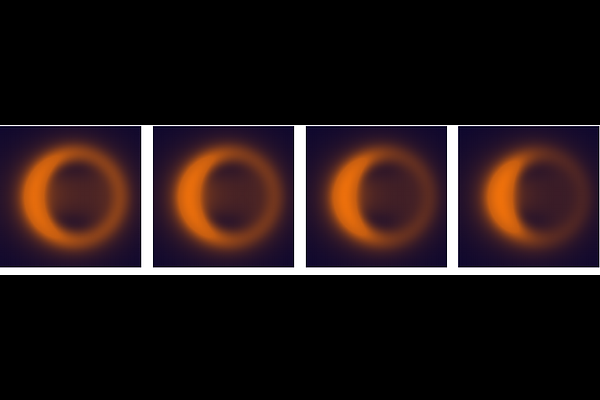
AbstractThis paper investigates the shadow and polarization images of a Kerr-Sen black hole illuminated by geometrically thick and optically thin accretion disks. We adopt two classes of accretion models, namely the phenomenological radiatively inefficient accretion flow (RIAF) model and the analytical ballistic approximation accretion flow (BAAF) model. Based on radiative transfer theory, we examine the effects of the spin parameter $a$, black hole charge $Q$, and observer inclination angle $θ$ on the shadow images. Both models show that, as the charge $Q$ increases, the photon rings and the central dark regions shrink simultaneously. Meanwhile, frame dragging gives rise to a pronounced brightness asymmetry, which becomes more significant with increasing $a$ and $θ$. The main difference between isotropic and anisotropic radiation is that, in the latter case, the higher order images are brighter in the upper and lower polar regions. For the BAAF model, because the conical approximation renders certain regions geometrically thinner, the spatial extent of the higher order images is narrower than that in the RIAF model, and the separation between the direct image and the higher order images is more distinct. In the polarization images, the spatial distribution of the polarization vector directions is mainly determined by gravitational lensing and frame dragging, whereas the intensity near the photon ring and the scale of the higher order images are significantly influenced by $Q$.