The mass density slope of early-type galaxies: newest results from the redshift distribution of strong gravitational lenses

The mass density slope of early-type galaxies: newest results from the redshift distribution of strong gravitational lenses
Xinyue Jiang, Shuo Cao, Wuzheng Guo, Chenfa Zheng, Chengsheng Mu, Shuaibo Geng, Marek Biesiada, Yalong Nan
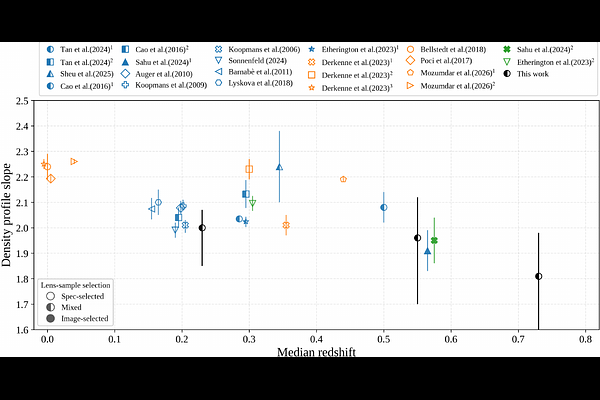
AbstractThe mass distribution of early-type galaxies (ETGs) encodes key information about baryonic processes and dark-matter assembly. In this paper, we propose a new framework to investigate the mass-density profiles of ETGs and their evolution with redshift, based on the redshift distribution of strong gravitational lenses. We compile 200 galaxy-scale strong lensing systems with complete information, including lens and source redshifts, Einstein radii, and spectroscopic velocity dispersions. To account for the heterogeneous construction of the compiled sample, we model a lens-redshift-dependent selection function for each survey category. By combining the lens-redshift distribution with velocity dispersion function (VDF) and spherical Jeans-based mapping, we obtain population-level constraints on the total mass-density slope gamma in three lens-redshift intervals, marginalizing over the luminosity-density slope delta and the stellar orbital anisotropy beta. We find that the total mass density of ETGs remains close to isothermal at low and intermediate redshifts ($γ=2.00^{+0.07}_{-0.15}$ at 0 < z_l < 0.5 and $γ=1.96^{+0.16}_{-0.26}$ at 0.5 < z_l < 0.6), with a shallower effective slope at higher redshift ($γ=1.81^{+0.17}_{-0.21}$ at $0.6<z_l\lesssim1.0$). The marginalized posteriors of delta and beta remain broad, consistent with $δ\simeq2$ and with isotropic orbits in all three redshift intervals. These results are consistent with the redshift trend predicted by Horizon-AGN simulations, in which active galactic nucleus (AGN) feedback, together with stellar assembly and merging, contributes to the structural evolution of ETGs. Applied to the much larger lens samples expected from future missions such as the Chinese Space Station Telescope (CSST), this method will enable tighter tests of density-slope evolution and its connection to galaxy formation processes.