Planetesimal formation via the streaming instability persists under turbulence driven by magnetorotational instability

Planetesimal formation via the streaming instability persists under turbulence driven by magnetorotational instability
Linn E. J. Eriksson, Ziyan Xu, Jeonghoon Lim, Chao-Chin Yang, Pinghui Huang, Mordecai-Mark Mac Low
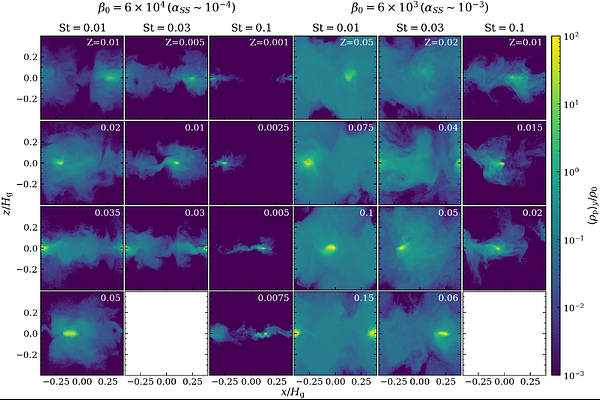
AbstractClumping by streaming instability (SI) leading to gravitational collapse is the leading proposed mechanism for forming planetesimals, the building blocks of terrestrial planets and giant-planet cores. The critical dust-to-gas density ratio above which the SI leads to dust concentration strong enough to result in collapse depends on local dust properties and disk conditions, such as particle Stokes number, pressure gradient, and turbulence. The role of turbulence has recently drawn attention because simulations have shown that even modest levels of istropically forced turbulence can significantly increase the critical dust-to-gas ratio. However, we show that this does not hold for turbulence self-consistently generated by the magnetorotational instability (MRI). We present the first parameter study of the SI in three-dimensional, stratified, shearing-box simulations including non-ideal magnetohydrodynamics with ambipolar diffusion. Modest turbulence yields a clumping boundary similar to pure SI cases, while stronger turbulence does increase the critical dust-to-gas density ratio, though less than in the models where turbulence is isotropically forced. Particle concentration occurs inside zonal flows, large-scale structures generated by the MRI. Our results suggest that self-consistent, MRI-driven turbulence does not necessarily inhibit planetesimal formation.