Timing and spectral analysis of the 2025 outburst of 4U 1630$-$47 with \textit{NICER}

Timing and spectral analysis of the 2025 outburst of 4U 1630$-$47 with \textit{NICER}
Haifan Zhu, Mariano Méndez, Xiao Chen, Wei Wang
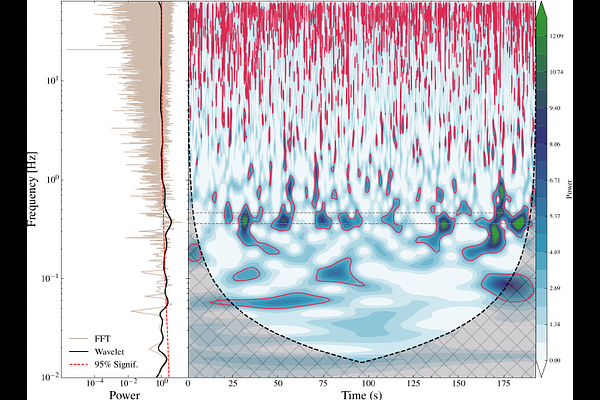
AbstractWe analyzed \textit{NICER} observations of the 2025 outburst of the black hole X-ray binary 4U~1630$-$47 to investigate the spectral--timing properties of its transient low-frequency quasi-periodic oscillations (QPOs) and millihertz-scale quasi-regular modulation (QRM). During the rising phase of the outburst, the QPO centroid frequency increased from $\sim 0.24$ Hz to $\sim 3.43$ Hz. Wavelet-based state separation shows that the with-QPO intervals are associated with a higher inner disk temperature and a lower \texttt{diskbb} normalization than the without-QPO intervals, while the photon index ($Γ$) shows weaker changes within the uncertainties. Near the outburst peak, the source displayed a weak QRM at $\sim 0.07$ Hz with a fractional rms amplitude of $\sim 4.7\%$, lower than that of the heartbeat state observed in 2023. Phase-resolved Hilbert--Huang analysis shows that the inner disk temperature is positively correlated with the X-ray flux, the \texttt{diskbb} normalization is anticorrelated, and $Γ$ varies only weakly. Overall, the short-timescale spectral--timing variability is expressed most clearly through the disk-related parameters. The transient QPOs are therefore consistent with short-timescale disk-related variability during the rising phase, whereas the millihertz-scale QRM may represent a weaker heartbeat-like variability mode appearing near the outburst peak.