The Galactic Centre G+0.633-0.0604 molecular cloud: a new astrochemical gold mine. I. Gas physical properties

The Galactic Centre G+0.633-0.0604 molecular cloud: a new astrochemical gold mine. I. Gas physical properties
D. San Andrés, L. Colzi, V. M. Rivilla, M. Sanz-Novo, S. Martín, I. Jiménez-Serra, S. Zeng
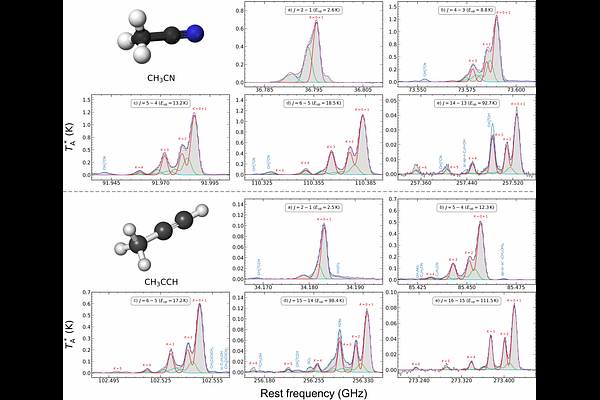
AbstractIn the Central Molecular Zone (CMZ), shocks play a key role in triggering star formation and driving chemical enrichment. The Sgr B2 complex is a prime template, hosting massive protoclusters (N, M, S) and the northern G+0.693 cloud, which exhibits shock-induced prestellar signatures. We report on G+0.633-0.0604, a newly identified shock-dominated and chemically rich cloud at the southern edge of Sgr B2, where the next star formation episodes are proposed. We characterise its physical properties and the shocks shaping it. We present analyses on CH$_3$CCH, CH$_3$CN, HC$_3$N, HNCO and several isotopologues of CO to infer the gas $T_{\rm kin}$ and density, using high-sensitivity spectral surveys from the Yebes 40m, IRAM 30m and APEX radio telescopes that covered ~100 GHz across the 31-275 GHz range. We also used 3 mm IRAM 30m mosaics (13'$\times$13') of Sgr B2 in HC$_3$N, HNCO and C$_2$H$_5$OH to probe G+0.633 environment. We identify three velocity components: a narrow main one (C1, $v_{\rm LSR}$~48.5 km/s; FWHM~10 km/s), and two broader, fainter components at higher velocities, C2 (~61 km/s; ~13 km/s) and C3 (~89 km/s; ~18 km/s), all showing similar properties ($T_{\rm kin}$~55-90 K, $N_{\rm H_2}$~(3-7)$\times$10$^{22}$ cm$^{-2}$, $n_{\rm H_2}$~(0.5-2.5)$\times$10$^{4}$ cm$^{-3}$) and extended distributions. C1 delineates G+0.633 physically and coincides with a peak in HNCO, supporting a shock-driven origin likely rooted in the cloud-cloud collision shaping Sgr B2 and also traced by C2, which extends north to G+0.693. C3 is kinematically unlinked and related to large-scale CMZ dynamics. Of the three, C1 may represent a very early protocluster phase, yet to be confirmed. G+0.633 thus emerges as a new shock-dominated CMZ cloud resembling G+0.693, providing another unique laboratory to investigate how shocks drive molecular complexity and regulate the onset of cluster formation in the CMZ.