Diffuse X-ray Emission in the Sagittarius C Complex

Diffuse X-ray Emission in the Sagittarius C Complex
Zhenlin Zhu, Mark R. Morris, Gabriele Ponti, Ping Zhou
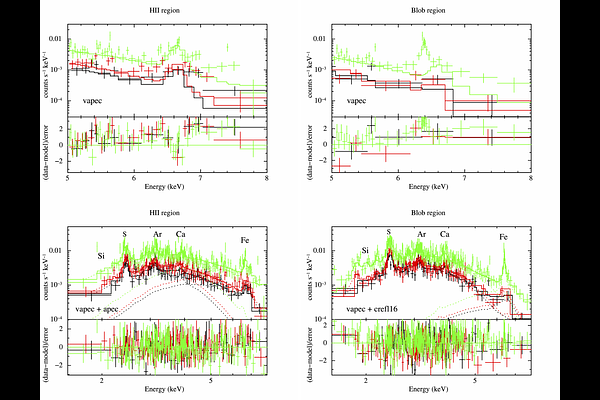
AbstractThe Sagittarius C (Sgr C) complex, located on the western edge of the Central Molecular Zone (CMZ), hosts a mixture of star-forming and non-thermal activity whose X-ray properties remain poorly understood. Using deep archival Chandra and XMM-Newton observations, we resolve the diffuse X-ray emission in Sgr C into two components: an H II region coincident with the radio peak and a brighter diffuse feature located to its southwest. Spatially resolved spectroscopy reveals the presence of a soft (kT <= 1 keV) plasma with metal abundances consistent with the elevated metallicity expected in the CMZ in both regions, along with a harder (~ 8 keV) thermal component within the H II region. The observed diffuse X-ray emission and its association with an expanding [C II] shell suggest that the hot gas may originate from a young supernova remnant (SNR) embedded in the H II region. Under this interpretation, the inferred shock velocity (~ 800 km/s) and SNR age (>= 1.7 kyr) are consistent with a core-collapse SNR in the Galactic Center. These results reveal Sgr C as a potential host of a SNR and highlight the complex interplay between massive-star feedback, magnetic fields, and molecular gas in the CMZ.