Magnetar Formation from Accretion Induced Collapse of White Dwarfs

Magnetar Formation from Accretion Induced Collapse of White Dwarfs
Luís Felipe Longo Micchi, Patrick Chi-Kit Cheong, David Radice
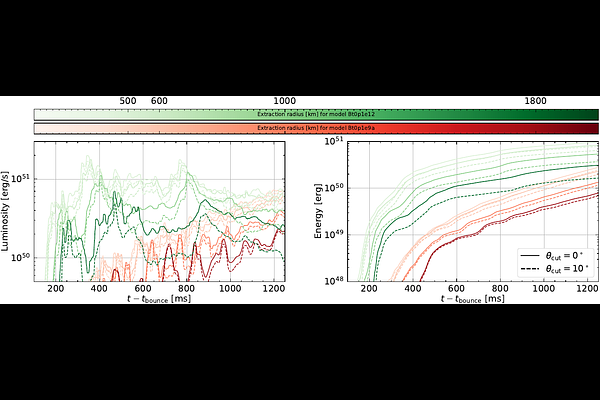
AbstractWe aim to characterize the post-collapse evolution of accretion-induced collapse (AIC) remnants of rapidly rotating, magnetized white dwarfs, focusing on their rotational, magnetic, and thermal structure, as well as the development of instabilities and their energy content. We perform nine axis-symmetric general-relativistic neutrino magnetohydrodynamic (MHD) simulations of collapsing, rapidly rotating, magnetized white dwarfs. The simulations follow the system from collapse through bounce and up to $\sim$1 s post-bounce. The simulations are performed by the conformally flat general relativistic neutrino MHD code \texttt{Gmunu}. The collapse produces a rapidly rotating proto-magnetar surrounded by a persistent accretion disk lasting at least $\sim 1$ s after bounce. The remnant mass and spin span 1.15--1.45 $M_{\odot}$ and 2.9--4.9 kHz, respectively, with stronger initial magnetic fields generally leading to lower rotation rates. During the first $\sim 10$ ms, the proto-magnetar exhibits global oscillations that drive both gravitational-wave emission and coherent modulation of the poloidal magnetic field energy. The magnetic energy evolution, normalized to its bounce value, follows an approximately universal behavior across all models. The remnant interior remains strongly magnetized ($\gtrsim 10^{13}$ G) and hot ($\gtrsim 20$ MeV) up to 1 s after bounce, with maxima of both quantities co-located in the inner $\sim 10$ km. The magnetic field topology shows surface poloidal fields of ${\sim}10^{12}$ G and toroidal fields of ${\sim}10^{14}$ G, with strong toroidal components extending into the equatorial region. When the magnetic energy exceeds the rotational energy ($\sim 10^{52}$ erg), the remnant core becomes unstable, leading to episodic magnetic flux expulsion, mass ejection, and flare-like activity in which magnetic energy is released and thermalized in the surrounding material.